Table of Content

Mines: Play Online in Demo Mode and for Real Money

Reviewed by: Claire Bennett, Senior iGaming Content Editor · Last reviewed: January 2026 (checked against the Australian/New Zealand Gaming Machine National Standard Revision 12.1, May 2025, and the VGCCC Wagering and Betting System Technical Standard, July 2024)

«Before evaluating any headline offer or multiplier potential in a grid-based instant game, inspect the underlying terms, random number generator certifications and withdrawal restrictions. A responsible editorial approach puts regulatory compliance and fine print before promotional claims.» — Claire Bennett, Senior iGaming Content Editor (source: editorial brief)

Provider

Stake Originals

RTP

99.00%

Volatility

Medium

Min bet

$0.10

Max bet

$100

Max win

$10,000

Mines Play Online in Demo Mode

Quick game sheet

ParameterSummary
Game typeInstant-win / crash-style grid game (a casino adaptation of Minesweeper)
Main providersSpribe, Hacksaw Gaming, Turbo Games, plus in-house "Originals" versions (BetFury, Stake)
Standard grid5x5 (25 tiles); alternative layouts 3x3, 7x7, 9x9 and even 12x12
Mine range1 to 24 mines on a 5x5 grid (up to 80 on the largest Hacksaw grids)
Reported RTPApproximately 96.00% to 99.02% depending on provider and configuration
VolatilityPlayer-controlled, set by mine count and cash out timing
Bet rangeFrom $0.001 to $0.10 minimum, up to $100 to $7,000 maximum, operator dependent
Demo modeYes: virtual credits, identical maths, no withdrawable winnings
FairnessCertified RNG and/or Provably Fair seed hashing, audited by labs such as iTech Labs or eCOGRA
Legal status (AU)Real-money online casino games are prohibited for Australian residents under the Interactive Gambling Act 2001; demo and social versions sit outside that prohibition
SupportBetStop self-exclusion register; Gambling Helpline 1800 858 858

In two sentences: Mines is a player-paced instant-win game where you uncover safe tiles to build a multiplier and cash out before hitting a mine. Nothing about the outcome can be predicted or manipulated, so the only real levers are stake size, mine count and the discipline to collect early.

Why this guide matters before you play

Most pages about the mines game read like a pitch. Big multipliers, a screenshot, a bonus button, done.

This one is built the other way around. It starts with how the maths actually works, then covers what you can verify yourself, then explains where the money and the legal risk sit. If you are an Australian reader comparing brands before a deposit, that order matters more than any headline figure.

Three questions drive almost every search around this title. Is Mines fair, or is the grid rigged? Can I try it free before committing anything? And what changes the moment real funds are involved? Each one gets a direct answer below, with the sources named rather than implied.

Mines is a fast-paced, interactive casino game inspired by classic grid-sweeping mechanics. Offered by software developers such as Spribe, Hacksaw Gaming and Turbo Games, the game replaces traditional slot reels with an interactive grid of hidden tiles. Players configure their own risk profile by adjusting the number of hidden mines on the board before selecting tiles to uncover multiplier payouts.

Whether you access it in free-to-play demo mode or assess it for real money availability, the game's mathematical structure, cash out mechanics and risk management principles are worth understanding before any active stake is placed.

Why this guide matters before you

What is the Mines game and how does it work

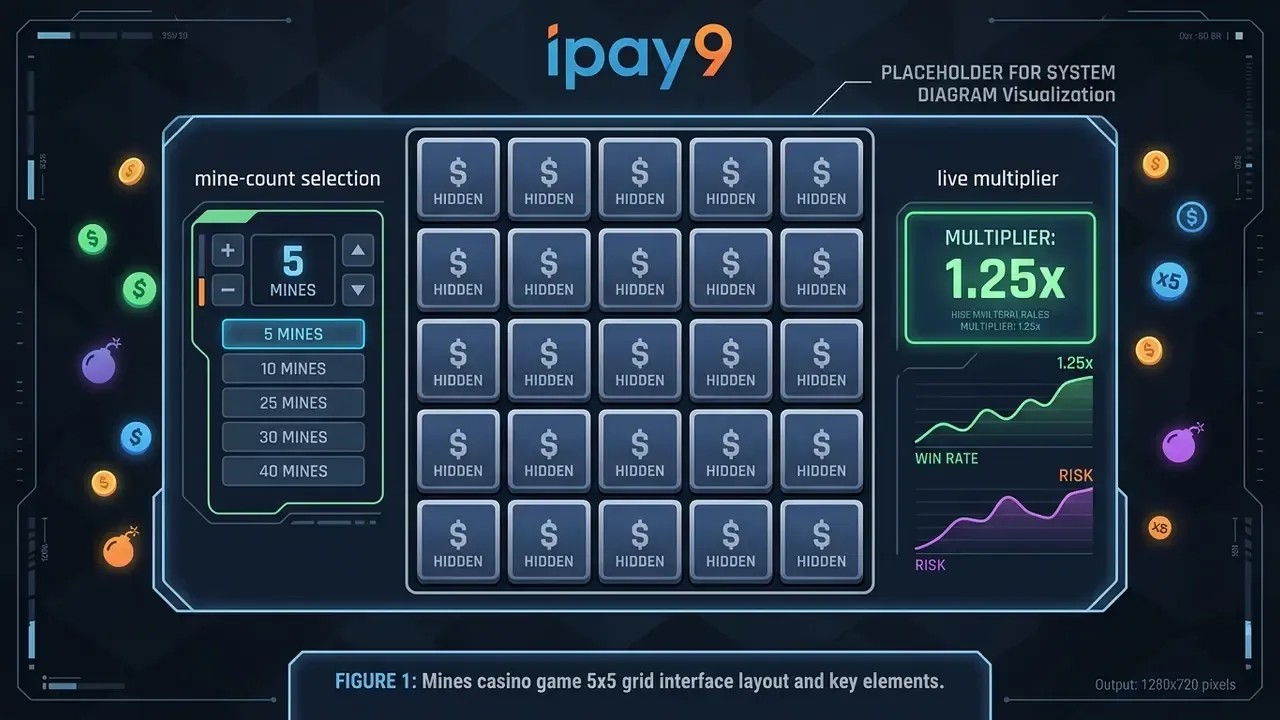
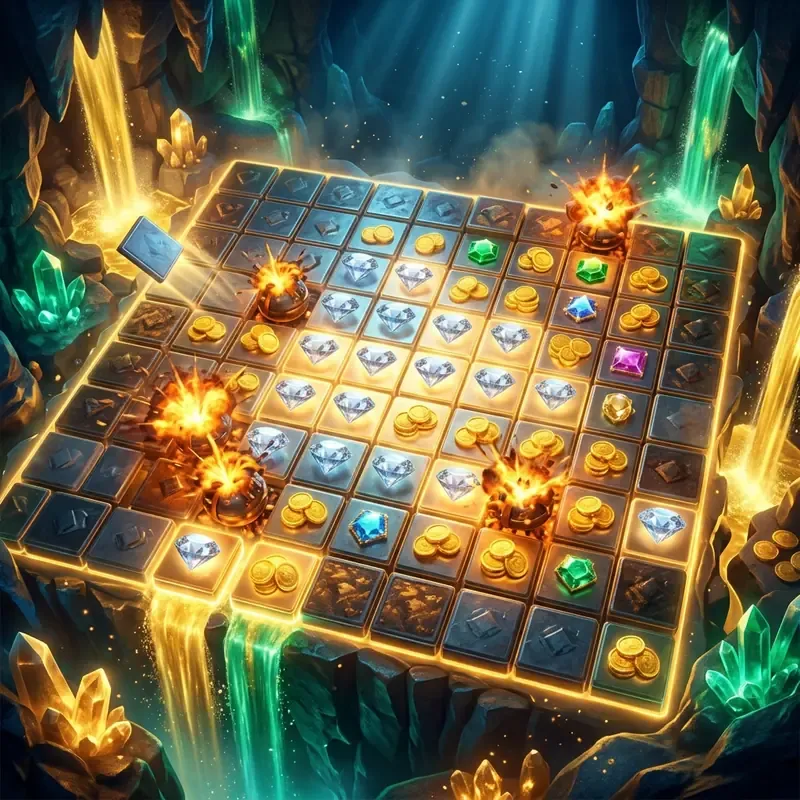
Mines is a grid-based instant-win casino game where the player uncovers hidden tiles on a board to build a payout multiplier while trying to avoid hidden explosive symbols. The standard game is hosted on a 5x5 grid containing 25 individual tiles. Behind each tile sits either a safe symbol (a gem, star, diamond or coin) or a mine.

The objective of the casino mines game is simple enough to explain in one line: click safe tiles to push the active payout multiplier higher. Every successful reveal increases the round's cumulative return. Uncover a single mine, though, and the round ends instantly with the stake forfeited.

What is the Mines game and

«Mines, as a game of chance in which stakes and prizes are determined by an RNG, falls within the category of prohibited interactive gambling services under Australian law.» — House of Representatives Standing Committee on Social Policy and Legal Affairs, Report on Online Gambling Impacts (2023). https://www.aph.gov.au/Parliamentary_Business/Committees/House/Social_Policy_and_Legal_Affairs/OnlineGambling

Mines 5x5 grid interface showing revealed safe symbols and hidden mines

Modern versions are built on cryptographic Provably Fair technology or certified hardware and software Random Number Generators (RNG). Provably Fair algorithms let players confirm independently, on the blockchain or through seed hashing, that mine locations were fixed before the round started and were not altered during play.

«The RNG must be physically or logically isolated from the rest of the system, and its algorithm submitted to the regulator for approval as part of certification.» — VGCCC Wagering and Betting System Technical Standard (July 2024). https://www.vgccc.vic.gov.au/resources/publications/wagering-and-betting-system-technical-standard

In regulated jurisdictions, independent testing laboratories such as iTech Labs or eCOGRA audit these systems to confirm the game engine stays unbiased. Hacksaw Gaming, for instance, states publicly that its Mines return figure was verified across more than 10 billion simulated rounds. That scale only makes sense once you treat RTP as a long-run statistical average rather than a session promise.

How to verify fairness yourself: a five-step check

  1. Open the game's information or "Fairness" menu (usually a gear or shield icon beneath the grid).
  2. Copy the server seed hash published before the round begins.
  3. Note the client seed. On most Provably Fair titles you can replace it with your own string.
  4. Play the round, then reveal the unhashed server seed at the end of the session.
  5. Re-hash the revealed seed with a public SHA-256 tool and confirm it matches the pre-round hash. A match means mine positions could not have been changed mid-round.

No seed disclosure, no lab certificate, no licence number in the footer? Then treat every other claim on that site, RTP included, as unverified. It takes two minutes to check and it filters out a surprising number of clone sites.

How to verify fairness yourself a

Grid size variations: from 3x3 to 12x12

Most guides describe only the classic 5x5 board. Grid size is actually a second, independent risk dial, and it changes both mine density and the shape of the multiplier ladder.
  • Mini grids (3x3, 9 tiles):maximum risk concentration. With even a single mine, one tile in nine ends the round, so opening multipliers start high and rounds resolve in seconds.
  • Standard grid (5x5, 25 tiles):the classic balance used by Spribe, BetFury Originals and Stake Originals, with 1 to 24 mines available.
  • Large grids (7x7 and 9x9, up to 81 tiles):offered in the Hacksaw Gaming build, where up to 80 mines can be placed. Bigger boards allow long strings of safe reveals with gentler multiplier steps.
  • Extended grids (12x12):used in some Originals-style builds, including the layout referenced in Stake.us low-risk setups, where each pick pays less but the chance of surviving a single click is comparatively high.
Grid size variations from 3x3 to
Grid sizeTotal tilesTypical mine rangeEffect on each safe pickBest suited to
3x391 to 8Large multiplier jumps, very short roundsHigh-volatility, single-pick play
5x5251 to 24Balanced ladder, familiar paytableStandard sessions and strategy testing
7x7491 to 48Smaller steps, longer safe streaksSession-length play with mid risk
9x9811 to 80Very gradual growth per pickExtended streak-building
12x12144Provider dependentLowest per-pick varianceConservative, low-volatility configurations

The key principle: on a larger grid each uncovered gem pays a smaller amount, but the probability of detonating on any single click falls. The trade-off between payout size and survival probability survives every layout, because the house edge is built into the paytable, not into the grid dimensions.

How to play Mines online: round rules

Playing Mines online comes down to four moves: set a stake, set the number of mines, click tiles to reveal safe multipliers, then cash out before you hit a mine. The whole sequence sits with the user, which gives you full authority over when to bank accumulated winnings and when to keep opening tiles.

To start a round, follow this standard flow:

  1. Set the active stake: choose the monetary amount or demo balance credit allocated to the round.

  2. Configure mine density: select how many hidden mines will be distributed across the 25-tile grid (commonly 1 to 24 mines).

  3. Choose the grid size, where available: 3x3, 5x5, 7x7 or 9x9 in provider builds that expose this setting.

  4. Initiate the round: confirm the settings with the "Bet" or "Start" button.

  5. Reveal tiles: click any covered tile. A safe symbol lifts the active multiplier.

  6. Decide on cash out: collect current winnings at the displayed multiplier, or click another tile and reach for more.

  7. Round conclusion: the round ends when you click "Cash Out" or uncover a mine, which loses the stake.

Most builds also show a payout bar above the grid displaying both the current multiplier and the next one. So the incremental value of one more click is visible before you accept the risk. Useful detail, often ignored.

Choosing your stake and the number of mines on the board

Your initial stake and the total number of mines govern both the statistical risk profile and the speed of multiplier progression. On a standard 5x5 grid of 25 tiles, operators usually allow anywhere from 1 up to 24 mines.
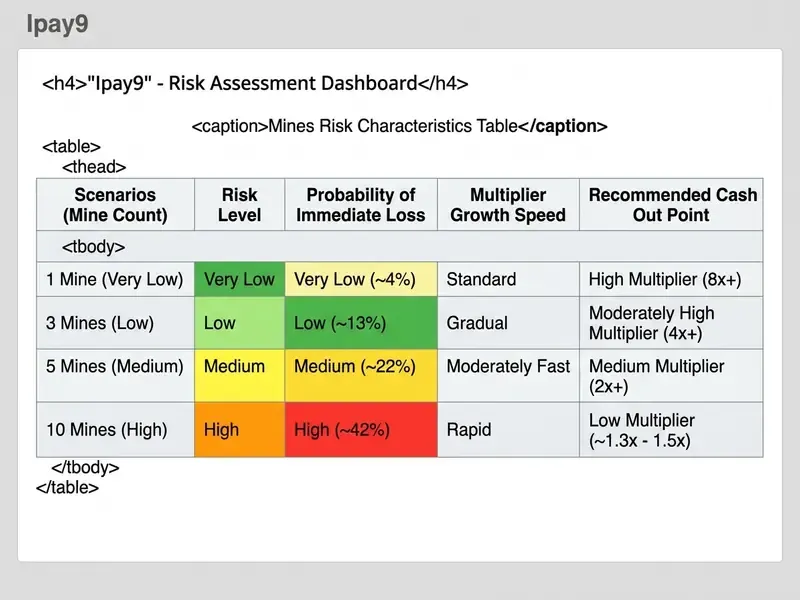
  • Low mine settings (1 to 3 mines):the probability of hitting a mine on the first click is low (4% for one mine, 12% for three). Multiplier growth per safe tile is slow, so meaningful returns need several successful clicks.
  • Medium mine settings (4 to 9 mines):a balanced curve between immediate risk and multiplier growth, which suits standard bankroll management approaches.
  • High mine settings (10 to 24 mines):the chance of an explosive tile on the first click is severe (40% for ten mines, 96% for twenty-four). One safe tile delivers a big multiplier jump, which is the entire appeal for players with extreme volatility tolerance.
Choosing your stake and the number

Presets matter here too. Most builds offer quick buttons for 1, 3, 5 and 7 mines plus a manual field for a custom value, so you can move between risk profiles without leaving the round screen.

When to continue a round and how cash out works

Cash out is the core decision in Mines. It lets you end a round and capture accumulated winnings at any point after at least one safe tile is revealed. The payout at any step is calculated directly:

Total payout = stake × current multiplier

Timing that decision means weighing payout goals against a shifting probability curve. As safe tiles leave the grid, the ratio of hidden mines to remaining unrevealed tiles rises. Each subsequent click therefore carries a higher chance of ending the round than the click before it. Cashing out on time secures gains instead of gambling them on lower-probability reveals.

A practical way to frame it: before every extra click, compare the incremental multiplier gain on the payout bar with the current probability of detonation. On a 5x5 board with 5 mines and three tiles already opened, 5 of the remaining 22 tiles are fatal. That is roughly a 22.7% chance of losing everything accumulated, for one incremental step.

When to continue a round and

Automation tools: Autoplay, hotkeys and live statistics

Professional Mines interfaces bundle tools that speed up play and strip some emotion out of the loop. They do not change the odds. They change your workflow.

  1. Autoplay or Auto mode: pre-select the tiles to be opened, the stake per round, the number of rounds and stop conditions (stop on loss limit, stop on win target, stop on single win). Auto mode requires that the number of picked tiles never exceeds the safe-tile count on the board.
  2. Autopick: the engine chooses the tile pattern randomly for you. Genuinely useful for proving to yourself that hand-picked "patterns" perform no better than random selection.
  3. Hotkeys: keyboard shortcuts (space to open a tile, "C" to cash out, for example) can accelerate a session several times over compared with mouse clicks. Key bindings are usually listed and configurable in the settings menu beneath the game.
  4. Live chart or balance graph: plots your balance curve and multiplier history in real time, which makes session variance visible rather than remembered.
  5. Statistics panel: the full betting history, including number of bets, win/loss ratio, total wagered and largest win. Honest self-analysis beats selective memory every time.
  6. Fast mode and animation toggles: shorten round animations on low-bandwidth connections. Handy for demo testing, risky for pace control with real money.
  7. Strategy presets: some in-house builds let you save dozens of custom bet-progression rules (BetFury advertises up to 50 saved strategies). The convenience is real; the mathematical advantage is not, as the section on progressive systems below explains.

Editorial caution: speed features multiply rounds per hour, which multiplies expected loss in a negative-expectation game. If you use autoplay or hotkeys, set a hard stop-loss and a session timer first, not later.

Automation tools Autoplay, hotkeys and live

Provider comparison: Spribe vs Hacksaw vs in-house Originals

Figures below are as published by providers and operators. Specific operators may configure alternative RTP bands or limits, so confirm the values shown inside the game's info panel.

Provider / platformReported RTPGrid size(s)Mine rangeBet rangeMax win / payout
Spribe Mines (2021)96.5% to 97.0%5x51 to 20$0.10 to $100Up to x5,000
Hacksaw Gaming Mines (2022)98.0%3x3, 5x5, 7x7, 9x91 to 80$0.20 to $1,000Up to x10,000
BetFury Original Mines99.02%5x51 to 24$0.001 to $7,000 (VIP $21,000)$100,000 (VIP $300,000)
Stake Originals MinesAround 99.0% (house edge 2.5% on some configs)5x5, 12x121 to 24Coin or token dependentOperator-capped
Turbo Games MinesOperator configurable5x51 to 24Operator dependentOperator dependent

Two practical takeaways. First, a single "Mines RTP" figure does not exist; claims such as "the RTP for Mines is 94%" apply to one operator-configured build, not the game category. Second, the highest advertised RTP does not make a session safer. BetFury's 99.02% build still allows a 24-mine configuration in which 96% of first clicks end the round.

Mines demo and Mines free: trying the game without risk

Mines demo modes give full access to the mechanics, interface and maths engine using non-cash virtual credits instead of real funds. As a free-play simulation, the demo lets you test grid configurations, study cash out behaviour and gauge volatility settings without financial exposure.

Regulatory context. Social casino and free-play products sit outside the Interactive Gambling Act 2001 because no real money is staked or won. But "free" is not the same as consequence-free.

Mines demo and Mines free trying

«Social casino games do not fall under the IGA as they do not involve real money; however, Australians spent approximately $115.8 million on such games in the first half of 2022 alone.» — House of Representatives Standing Committee on Social Policy and Legal Affairs, Report on Online Gambling Impacts (2023). https://www.aph.gov.au/Parliamentary_Business/Committees/House/Social_Policy_and_Legal_Affairs/OnlineGambling

That number matters because in-app purchases of virtual currency create real spending inside a legally non-gambling product. Where a platform offers an internal non-withdrawable currency instead of a classic demo balance (BetFury's FunFury being one example), it functions as a demo. Still, the pathway from free tokens to paid tokens should be treated as a spending decision, not a game setting.

Demo mode uses the same Random Number Generator logic as paid versions, so multiplier scales, tile probabilities and payout structures stay consistent between the mines free environment and real money play.

Playing Mines free lets you:

  1. Check how responsive the touch controls feel on mobile or desktop.
  2. Watch how changing the number of mines, and the grid size, reshapes multiplier growth.
  3. Test personal cash out thresholds across long trial sessions without losses.
  4. Compare "pattern" clicking against Autopick over several hundred rounds and see the outcomes converge on the same distribution.

One documented psychological caveat: demo balances are usually generous and refillable, which trains cash out habits that no real bankroll can sustain. Treat the demo credit as if it were your actual session budget. Otherwise the practice transfers nothing useful, and arguably it teaches the wrong reflex.

That number matters because in-app purchases

Mines casino for real money: access, offers and safeguards

Legal and financial disclaimer: this information is general in nature and is not legal or financial advice. Real-money wagering with online casinos is prohibited for Australian residents under the Interactive Gambling Act 2001, and the ACMA blocks access to many offshore casino sites. Check the legislation in your own jurisdiction before registering on any platform.

Mines real money play shifts the game from a risk-free simulation to a monetary wagering transaction, which requires a funded account at a licensed casino operator. In real money mode, verified deposits fund active stakes, and successful cash outs produce withdrawable payouts subject to identity checks and operator rules.

When you assess an iGaming operator offering a real money mines casino game, look at the fundamental trust signals:

Mines real money play shifts the
  • Licensing and regulatory compliance:the operator holds a valid licence from an established authority, with the licence number and licensing body stated in the footer and verifiable on the regulator's own register.
  • Payment processing and limits:available deposit and withdrawal channels, processing timeframes and fee structures, including minimum withdrawal amounts and weekly or monthly payout caps.
  • Account verification protocols:transparent Know Your Customer (KYC) procedures in place before deposits are accepted, not sprung on the player at withdrawal.
  • Game-level transparency:RTP, provider name and Provably Fair verification reachable from inside the game window.
  • Responsible gambling tooling:deposit limits, loss limits, session reminders, cooling-off and self-exclusion.
Ipay9 heading-banner

The cost of getting this wrong is measurable:

«Online gamblers in Australia report gambling-related harm 2.2 times more often than land-based-only gamblers: 34% versus 15.6%.» — House of Representatives Standing Committee on Social Policy and Legal Affairs, Report on Online Gambling Impacts (2023). https://www.aph.gov.au/Parliamentary_Business/Committees/House/Social_Policy_and_Legal_Affairs/OnlineGambling

Compare the documented evidence before you act on a promotional claim or register on any gaming platform.

Operator verification scorecard

Rather than trusting a "top brands" list, score the operator yourself before a first deposit. Six or more failed rows means walk away.

CheckWhat "pass" looks likeRed flag
LicenceNumber, licensee entity and regulator verifiable on the regulator's register"Licensed and regulated" with no number
Game providerSpribe, Hacksaw or Turbo Games branding inside the game frameUnbranded clone with no provider info
Fairness proofSeed hash and verification page availableNo fairness menu, no lab certificate
TermsWagering contribution, max bet with bonus and withdrawal caps stated in plain figuresVague "bonus abuse" clauses only
KYC timingDocuments requested at registration or before the first withdrawal, with a stated turnaroundKYC introduced only after a big win
PaymentsNamed methods, stated fees, stated payout windows"Instant withdrawals" with no method list
RG toolsDeposit and loss limits, self-exclusion, links to help servicesLimits available "on request" only
SupportLive chat plus email with a response SLAContact form only

Who should skip Mines for real money

Not every reader should be nudged toward a deposit, and a review that pretends otherwise is selling rather than reviewing. Skip real money play if any of the following describe you.

  • You live in Australia and want certainty about legality. Real-money online casino games are a prohibited service here, full stop.
  • You are chasing a loss from another game or another session. The mines gambling loop is fast, and fast loops punish chasing hardest.
  • You plan to clear a welcome bonus mainly on Mines. Reduced wagering contribution can make that arithmetic brutal, as the worked example below shows.
  • You need withdrawals to be predictable. Instant games are quick; payout processing after KYC is not.
  • You want a system that produces income. No configuration of grid, mine count or staking pattern removes the house edge.

Anyone who mainly wants to understand the mechanics has a better option available at zero cost: the demo.

Who should skip Mines for real

Deposits, bonuses and wagering conditions before you start

Claiming a welcome bonus to play Mines calls for a careful read of the operator's terms. Many casino bonuses carry restrictions aimed squarely at instant and crash-style games:

  1. Wager contribution weighting: slots often contribute 100% toward bonus wagering, while grid and crash games like Mines may contribute a reduced percentage (5% to 20%) or nothing at all. Worked example: a $100 bonus with 40x wagering needs $4,000 in turnover; at 10% contribution, playing only Mines means $40,000 of actual Mines turnover to clear it.
  2. Maximum stake caps: terms frequently enforce a maximum bet (for example $5 per round) while a bonus is active. Exceed it and bonus funds plus associated winnings can be voided.
  3. Cash out multiplier restrictions: some promotions require bets placed with bonus funds to reach a minimum multiplier, say 1.5x, before a cash out counts. That quietly forces a higher-risk configuration than you might otherwise pick.
  4. Winnings caps on bonus play: a maximum conversion of, for instance, 5x the bonus amount can make a large Mines multiplier irrelevant on paper.

Transparency about your own activity is a documented protective factor too:

Deposits, bonuses and wagering conditions before

«Showing players an activity statement reduced amounts staked by 7.6% (Statement A) and 4.9% (Statement B) compared with a control group receiving no notifications.» — BETA "Better Choices" Report, Department of Social Services (2023). https://behaviouraleconomics.pmc.gov.au/projects/better-choices-improving-activity-statements-online-wagering-consumers

Always read the current terms on the operator's official site before opting into any promotional bonus, and switch on account statements or activity summaries where the platform offers them.

Payments and payouts: what Australian readers ask about

Presented for information only. Availability depends on the operator and on the legal restrictions described in the disclaimer above.

MethodTypical deposit speedTypical withdrawal speedNotes and risks
PayID / OskoNear-instantOften same day to 24 hours where supportedBank may decline or block gambling-coded transfers
Bank transfer1 to 3 business days1 to 5 business daysSlowest, but leaves a clear audit trail
Visa / Mastercard debitInstantFrequently unavailable for payouts; refunds routed back to cardCard issuer gambling blocks are common in Australia
Neosurf voucherInstantNot a payout method, so an alternate channel is requiredUseful for hard deposit limits; no chargeback path
Cryptocurrency (BTC, ETH, USDT)MinutesMinutes to hours after approvalNetwork fees, price volatility, no consumer chargeback
e-walletsInstantHours to 2 business daysMany e-wallets exclude gambling merchants

Three points worth internalising. Withdrawal timeframes start after KYC approval, not when you click "withdraw". Payout caps are often expressed per week or per month. And offshore sites can be blocked at ISP level by the ACMA at any time, which is a genuine access and funds-retrieval risk rather than a theoretical one.

Responsible Gambling and Legal Compliance Notice: real money gambling is restricted to adults aged 18 years or older, or the legal age of majority in your jurisdiction. Interactive online casino games played for real money face strict legal prohibitions in certain jurisdictions, including Australia under the Interactive Gambling Act 2001. This content is provided for informational and educational comparison only. Gambling should never be treated as a financial strategy or a source of income. Set strict deposit and loss limits before playing. If gambling stops being recreational, use self-exclusion registers such as BetStop or contact support services like the Gambling Helpline on 1800 858 858.
Three points worth internalising. Withdrawal timeframes

How real money play differs from demo mode

The maths engine and RNG behind Mines are identical in both modes. What real money adds is financial consequence, emotional pressure and regulatory obligation.

Feature / dimensionMines demo modeMines real money mode
Balance typeVirtual demo creditsReal fiat or cryptocurrency funds
Financial riskZero financial exposurePotential total loss of the active stake
Payout eligibilityNon-withdrawable virtual pointsWithdrawable real money payouts
Verification (KYC)Not requiredMandatory before withdrawal
Bonus interactionNoneWagering weighting, max bet caps, win caps
Legal status (AU)Outside the IGA (no real money)Prohibited service for Australian residents
Psychological factorsRisk-free exploration, zero stressDiscipline required to manage loss-chasing impulses

RTP, multipliers and risk in Mines

Return to Player (RTP) in Mines is the theoretical percentage of total wagered money the game returns to players across millions of rounds. Published figures across certified titles sit roughly between 96.00% and 99.02%: Spribe reports 96.5% to 97.0%, Hacksaw Gaming 98.0%, BetFury Originals 99.02% and Stake Originals around 99.0%. Individual operators may deploy alternative configurations, so the in-game info panel remains the only authoritative figure for the build in front of you.

Regulators treat this disclosure as a baseline requirement, not a marketing nicety:

«The standard requires that players have access to the game's RTP, the definition of RTP, the odds of the five highest and five lowest value combinations, and maximum and minimum bets.» — Australian/New Zealand Gaming Machine National Standard Revision 12.1 (May 2025). https://www.gamblingregulation.nsw.gov.au/resources/gaming-machine-national-standard

Volatility here is dynamic rather than fixed by the developer. You configure it through mine count, grid size and cash out timing. That player-set volatility is one reason Mines sits alongside crash titles in the fastest-growing category of the iGaming market.

Mine settingProbability of mine on 1st clickMultiplier growth speedRisk profileTypical cash out point
1 mine4.0% (1 of 25)Very slow incrementMinimal immediate riskAfter 3 to 5 safe reveals
3 mines12.0% (3 of 25)Moderate incrementLow riskAfter 2 to 3 safe reveals
5 mines20.0% (5 of 25)Balanced accelerationMedium riskAfter 1 to 2 safe reveals
10 mines40.0% (10 of 25)Rapid accelerationHigh riskAfter 1 safe reveal
15 mines60.0% (15 of 25)Extreme accelerationVery high riskImmediate first-tile cash out
24 mines96.0% (24 of 25)Single-step jackpot logicExtremeForced single-click round

Note: the table illustrates theoretical probability models on a standard 25-tile grid. Higher mine counts sharply increase the likelihood of losing the initial stake on the very first click, compensated by faster multiplier increments.

How the number of mines affects multipliers and potential payout

The number of mines you choose sets the exact odds for every reveal. On a 25-tile board, uncovering a safe tile with 15 mines hidden is far less likely than uncovering one with only 2 mines in play.

Because potential payout is inversely proportional to probability, more mines lift the multiplier progression rate dramatically. Indicative first-step values from published paytables follow, and exact figures vary by provider and grid size, so read the in-game payout bar:

  • With 1 mine:the first safe tile gives a marginal uplift, typically in the low 1.0x range.
  • With 5 mines:the first safe tile gives a noticeably larger step, commonly around 1.2x.
  • With 10 mines:the first safe tile gives a substantial jump, commonly around 1.6x.
  • With 20 or more mines:the first safe tile can pay several times the stake, precisely because reaching it is so unlikely.
Ipay9 heading-banner

Potential payout scales quickly with each successive safe reveal under high mine counts, while the cumulative risk of detonation compounds with every extra click. The compounding is easy to underestimate. Surviving five clicks with 5 mines on a 5x5 board is five separate probabilities multiplied together, not a single 80% event.

Why RTP does not guarantee a win in an individual session

A common misconception is that a 98% RTP guarantees $98 back for every $100 wagered in one session. In reality, theoretical RTP is calculated across an effectively infinite distribution of rounds.

«RTP is the ratio of total wins to total turnover over a game cycle; short-term variance can deviate substantially from the theoretical value.» — Australian/New Zealand Gaming Machine National Standard Revision 12.1 (May 2025). https://www.gamblingregulation.nsw.gov.au/resources/gaming-machine-national-standard

Across 10 or 50 rounds, variance dominates. Under configurations with 5 or more mines, a player can easily run into a long sequence of losing rounds where the stake disappears on the opening click. Theoretical RTP is a metric for long-term fairness auditing, not a forecasting formula. The law of large numbers only drags results toward the average across enormous numbers of trials, and a human session is never enough trials for that to bite.

Mines strategy: managing stake and risk

Because Mines relies on independent Random Number Generators or Provably Fair cryptography, no mines strategy, software tool or pattern overlay can move the underlying probabilities. Workable strategies deal with financial control, stake sizing and objective risk management, and nothing else.

Population-level data explains why bankroll rules matter more than "systems":

«More than 70% of regular online bettors are at risk of gambling-related harm; 21.4% meet the criteria for high-risk gambling on the harm scale.» — AIFS National Gambling Trends Study (NGTS) 2023 Snapshot, Australian Institute of Family Studies. https://aifs.gov.au/resources/research-and-statistics/national-gambling-trends-study

Responsible play therefore means strict session budgets, a stake capped as a fixed percentage of the bankroll, and cash out thresholds decided before the session rather than mid-round.

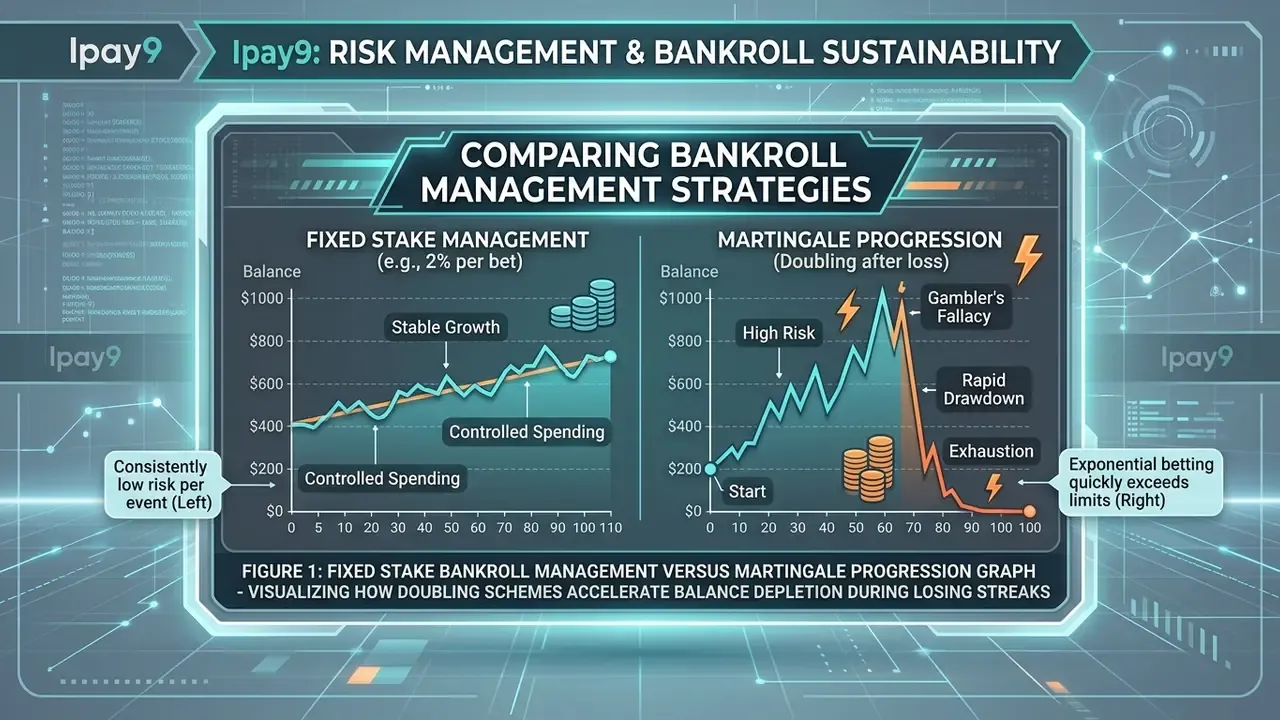
Flat staking versus progressive systems (Martingale)

Low-risk approach: small stake, fewer mines, early cash out

The low-risk approach suits players who want longer playing time and smaller balance swings. It prioritises stability over big multipliers:
  • Minimal mine setup:1 to 3 mines on the 5x5 grid, or a larger grid to dilute mine density further.
  • Small, fixed stake:cap the stake per round at 1% to 2% of your session balance.
  • Early cash out:target a conservative exit after one or two safe tiles.
  • Session rules:set a stop-loss and a win target before the first click, then honour whichever arrives first.
Low-risk approach small stake, fewer mines

Payouts are smaller this way, and the probability of immediate loss drops, which helps bankroll stability across longer sessions. Even so, low-risk play keeps a negative mathematical expectation because of the built-in house edge. Extending playing time in a negative-expectation game extends exposure. It does not create profit.

Why patterns, Martingale and "hacks" do not guarantee a win

Plenty of promotions claim that visual patterns (corners, cross shapes), Martingale doubling or third-party "Mines predictor" apps guarantee profits. Mathematically, those claims are false:

  1. Independent RNG events: mine placement is generated randomly for each round. Previous outcomes have zero influence on future positions. Grid patterns offer no statistical advantage; they only make a session faster, which raises turnover.
  2. The Martingale trap: doubling after every loss needs an infinite bankroll and no table limits. Six or seven consecutive losing clicks produce exponential stake growth that overruns account balances or operator maximum bet rules. A $1 base stake becomes $64 on the seventh round and $1,024 on the eleventh, while the bonus-linked max bet cap may sit at $5.
  3. Predictor "hacks" and scams: external software and "predictor APK" files cannot read or decrypt isolated RNG seeds held on secure servers.
Why patterns, Martingale and hacks do

«Licence standards require RNG isolation, host- and network-based intrusion detection and DMZ architecture; external access to RNG seeds is technically impossible in certified systems.» — Tasmanian Gaming Licence Standards (October 2023). https://www.treasury.tas.gov.au/liquor-and-gaming/gaming/gaming-licence-standards

So any product marketed as a "Mines predictor", "signal bot" or "hack" is deceptive by construction. In practice these downloads harvest credentials, install spyware or funnel users to unlicensed clone sites, and several ask for casino login details outright. Treat every round as an independent event of chance, and install nothing.

Disclaimer: this information is general in nature and does not replace professional advice. Gambling carries the risk of financial loss. If you notice signs of dependency, contact the Gambling Helpline on 1800 858 858 or register with BetStop.

Why progressive systems (Paroli, D'Alembert, Oscar's Grind) do not change expectation

In-house Mines builds increasingly ship with pre-programmed staking systems. Knowing what they actually do keeps you from mistaking convenience for edge:
  • Martingale:double the stake after each loss, return to base after a win.
  • Delayed Martingale:wait for a set number of consecutive losses before doubling begins.
  • Half-Martingale:double after a loss, but raise the base stake by half after a win.
  • Paroli (reverse Martingale):double the stake after each win until a target is reached.
  • D'Alembert:increase the stake by one fixed unit after a loss, decrease by one unit after a win.
  • Oscar's Grind:aim for one unit of profit per cycle, raising the stake only after winning rounds.
Why progressive systems Paroli, D'Alembert, Oscar's

The mathematical verdict: every Mines round is an isolated trial resolved by an independent RNG. Changing the stake between rounds redistributes risk across time. It alters the shape of the outcome distribution, giving more small wins and rarer catastrophic losses, or the reverse, but it cannot alter the expected value of any single round. With a house edge of roughly 1% to 3% depending on the build, long-run expectation stays negative under every progression. Systems that appear to "work" in short tests are simply harvesting frequent small wins while concealing a rare, high-magnitude loss.

Two structural constraints close the argument. Operator maximum bet limits truncate any doubling sequence, and finite bankrolls guarantee that a long enough losing run ends the progression rather than resetting it.

The mathematical verdict every Mines round

Mines mobile and download: playing on a smartphone

Modern Mines games are built with responsive cross-platform web frameworks (HTML5). Players reach the full game through standard mobile browsers such as Chrome, Safari or Firefox on iOS and Android, without downloading native application files (.apk or .app). So Mines download, as a step, is not required at all.

«Online gambling is most prevalent among 25 to 34-year-olds (61%) and declines to 21% among those aged 75 and over; mobile devices are the primary access channel.» — Victorian Population Gambling and Health Study 2023, VGCCC. https://www.vgccc.vic.gov.au/resources/publications/victorian-population-gambling-and-health-study

That concentration among younger, mobile-first players is exactly why phone-based session controls matter more than any in-game feature: screen-time limits, deposit limits, notifications switched off.

Running Mines mobile in the browser brings clear operational advantages:

  • Zero storage requirements:open the game instantly, with no internal storage used and no installation wait.
  • Touch-optimised interface:grid tiles, stake buttons and cash out controls are enlarged and recalibrated for touch; larger grids (7x7, 9x9) often want landscape orientation for comfortable tapping.
  • Cross-platform consistency:a single HTML5 codebase renders through the device's browser engine, so behaviour depends on browser support rather than platform-specific binaries.
  • Platform security:the browser sandbox means game code is served directly from certified, encrypted operator servers.
Ipay9 heading-banner

«Regulatory standards oblige operators to maintain host-based and network-based intrusion detection, DMZ architecture and the ability to forcibly terminate remote sessions.» — Tasmanian Gaming Licence Standards (October 2023). https://www.treasury.tas.gov.au/liquor-and-gaming/gaming/gaming-licence-standards

Download warning: the browser build is complete, so any site pushing a "Mines APK", "Mines mod" or "Mines predictor app" is offering something the legitimate game does not need. Sideloaded gambling APKs remain a common vector for credential theft on Android.

FAQ

Can I legally play Mines for real money in Australia?

No. Real-money interactive casino games are prohibited services for Australian residents under the Interactive Gambling Act 2001, and the ACMA blocks many offshore casino domains. Free demo and social versions fall outside that prohibition, because no real money is staked or won.

Is the demo version mathematically the same as the real-money game?

Yes. Certified builds use the same RNG logic, the same paytable and the same multiplier ladder. What differs is the balance type (virtual credits), the absence of withdrawals and the absence of financial pressure.

What is the RTP of Mines?

It depends on provider and configuration: roughly 96.5% to 97% for Spribe, 98% for Hacksaw Gaming, 99.02% for BetFury Originals and about 99% for Stake Originals. A single "Mines RTP" figure, such as the 94% quoted in some guides, reflects one operator-specific build rather than the game category.

What is the minimum bet in Mines?

Commonly $0.10 in the Spribe build and $0.20 in the Hacksaw build; some in-house versions accept fractions of a cent in crypto. Maximums run from $100 to several thousand dollars, again operator dependent.

How many mines can I set?

From 1 to 24 on a standard 5x5 grid, and up to 80 on the largest Hacksaw grids. Some builds narrow the range, with Spribe commonly offering 1 to 20.

When should I cash out?

There is no universally optimal point, because every configuration carries the same built-in house edge. In practice, low-risk players collect after one or two safe reveals; the longer a round runs, the higher the chance the next click ends it.

How do I check that a round was fair?

Open the Fairness or Provably Fair menu, record the pre-round server seed hash, play, then re-hash the revealed seed and confirm the match. If the site exposes neither seeds nor lab certification, you cannot verify anything at all.

Do Mines predictor apps or bots work?

No. Certified systems isolate the RNG behind intrusion detection and DMZ architecture, so seeds cannot be read externally. Predictor downloads are scams, and frequently malware as well.

How long do withdrawals take?

After KYC approval: often same-day to 24 hours for PayID where supported, minutes to hours for crypto, and one to five business days for bank transfers. Weekly and monthly payout caps may apply.

Which grid size is safest?

Larger grids lower the chance of detonating on any single click, but they pay less per reveal. Risk is redistributed, not removed.

Responsible gambling and support

Gambling is entertainment with a negative expected value, never an income strategy. If any of the following apply, take a break and seek support: chasing losses, betting more than budgeted, hiding your play from others, or borrowing to fund a session.
  • Gambling Helpline (Australia):1800 858 858, available 24/7, free and confidential.
  • BetStop:the national self-exclusion register for online wagering.
  • Operator tools:deposit limits, loss limits, session reminders, cooling-off and self-exclusion. Activate them before you deposit, not after a loss.
Responsible gambling and support. Gambling is

This article is informational and educational. It is not legal, financial or medical advice. Age restriction: 18+, or the legal age of majority in your jurisdiction.

Appendix A: Editorial corrections log

For transparency, the following changes were made during the latest review:

  1. Removed market-analysis claims about operator transparency and about strategies that "bypass RNG mechanics". The earlier edition attributed these to a commercial market analysis with no methodology, sample or accessible URL. They now sit replaced by population-level findings from the AIFS National Gambling Trends Study (2023) and the House of Representatives Standing Committee report (2023).
  2. Strengthened weak citations. References to the Interactive Gambling Act 2001, the BETA "Better Choices" report and the Tasmanian Gaming Licence Standards were replaced with quantified statements and direct source URLs.
  3. Reframed unsourced multiplier figures. First-step multiplier values are presented as indicative ranges drawn from published paytables, with a note that exact figures vary by provider and grid size.
  4. Harmonised language. Headings, captions and body text are now consistently in Australian English, which removes the earlier mixed-language presentation.
  5. Added missing coverage. Grid-size variations (3x3 to 12x12), a provider comparison table, automation tooling (Autoplay, Autopick, hotkeys, live charts, saved strategy presets), progressive staking systems, payment and payout information, an operator verification scorecard, a "who should skip this game" block, a fairness self-check procedure and an FAQ section.
  6. Refreshed the review date. Sources and regulatory references were re-checked in January 2026; provider RTP and limit figures should still be confirmed in-game, since operators reconfigure builds without notice.
Appendix A Editorial corrections log. For