Poker Online in 2026: Rules, Formats, Strategy and Real-Money Play in Australia
Last updated: 12 February 2026 · Reviewed by: iGaming editorial desk · Reading time: about 35 minutes

Last updated: 12 February 2026 · Reviewed by: iGaming editorial desk · Reading time: about 35 minutes
Written and tested by: Daniel Rourke, poker analyst and reviewer with nine years in the gambling industry, including six years grinding NL10 to NL200 cash games and low buy-in MTTs across AEST evenings. Edited by: Claire Bennett, senior casino content editor, terms-first approach. Reviewed by: the iGaming editorial desk, which maintains our testing protocol, licensing checks and responsible-gambling standards.
Our testing protocol for this guide: we opened real accounts at 11 poker rooms and poker-facing casinos, funded each of them with our own money (typical deposits AU$20 to AU$150), played more than 500 hands per site during Australian evening hours (17:00–22:00 AEST and 17:00–20:00 AWST), completed identity verification (KYC), then requested withdrawals and timed each one with a stopwatch from "request submitted" to "funds received". Every payout figure in this article is a measured result, not a marketing claim.
Key takeaway: poker online is a skill game wrapped in a gambling product. Treat the skill part seriously (ranges, position, bankroll) and treat the gambling part conservatively (limits, verified sites, money you can afford to lose).
This is not a promotional page. It is a reference for two kinds of reader.
The first is someone who has never played poker for money and wants the rules, the hand rankings and a realistic sense of cost before opening an account. The second is a player who already knows one or two brands and is checking bonus terms, withdrawal times and complaint history before depositing again. Both groups need the same thing: restrictions explained as clearly as benefits.
What we measured, plainly: licence jurisdiction and corporate entity, published RNG audit evidence, table and tournament counts by hour during Australian evenings, bonus release mechanics and game weighting, deposit and withdrawal methods available locally, timed payouts on real balances, support response speed on a genuine question, and the responsible-gambling tools built into each client.
What we did not measure, and will not pretend to: long-run win rates for any individual player, the fairness of a shuffle beyond the published audit, and the effect of coaching tools on results. Where evidence is missing, we say so rather than filling the gap with vendor language.
One more framing note. Poker sits oddly inside the wider casino world. It is the only common product where your main opponent is another person rather than a paytable. That single difference changes the bankroll maths, the bonus maths and the risk profile, so it shapes almost every section below.
"Poker online" is not a single object of study. In the research and policy literature it covers at least four distinct products: peer-to-peer cash games and tournaments in dedicated poker rooms; casino-style poker played against a paytable (video poker, Caribbean Stud, Three Card Poker, Oasis Poker); poker live dealer tables streamed from a studio; and free-to-play or "demo" poker offered in social apps and inside real-money lobbies. Each has a different risk profile, a different skill component and a different regulatory treatment, which is why online poker requires tailored evidence rather than being quietly folded into generic gambling data.
That distinction is legally consequential. Poker's substantial skill component has been used in several jurisdictions to argue for separate regulatory treatment, a view echoed by Australian senators who have advocated regulation and taxation rather than prohibition.
"Indian courts have recognised online poker as a game where skill predominates, extending it constitutional protection under freedom of trade."
Source: analysis of India's Promotion and Regulation of Online Gaming Act (2023–2025).
This international precedent strengthens the "skill versus chance" argument. It does not change Australian law. Here, the policy debate has repeatedly returned to a Senate inquiry into online poker and the Commonwealth response to it.
"Amendments to the Interactive Gambling Act 2001 prohibited licensed operators from offering real-money online poker to Australian residents."
Source: Australian Government response to the Environment and Communications References Committee, Online Poker report (2023–2025).
The consequence for consumers is straightforward. If a Curaçao or Costa Rica licensed room refuses a withdrawal, an Australian player has no domestic regulator to appeal to, and no access to Australia's National Consumer Protection Framework for Online Wagering, which applies to licensed wagering providers rather than offshore poker sites. That framework's ten-point minimum package (activity statements, deposit limits, consistent staff training, restrictions on inducements and a national self-exclusion register) is still a useful benchmark to judge any site against, even when the site is not bound by it.
Key takeaway: offshore licences are a starting point for due diligence, not a guarantee. Judge a room by its payout history, its published terms, its RNG audit evidence and the responsible-gambling tools inside the client, not by the logo in the footer.
Every poker product discussed here is strictly for adults. In Australia the gambling age is 18. In some jurisdictions it is 21. Age limits and legality are set by national or subnational law rather than by a single global rule, and the World Health Organization's ICD-11 recognises gambling disorder as a clinical condition, which is why age gating is a health measure and not just a formality.
Age controls matter because the research shows that early exposure to gambling-like mechanics is common.
"Loot boxes and sports betting were the most common forms of online gambling among young adults in the ACT, with many reporting they began before turning 18."
Source: ANU study of young adults in the ACT (2023–2025).
"Adolescent engagement (ages 12 to 17) with loot boxes and social casino games was associated with higher odds of subsequent gambling and gambling harm."
Source: NSW Youth Gambling Study (2020).
Practical implications for anyone reading a poker guide: do not share account credentials with minors, use device-level parental controls if children use your computer or phone, and do not treat "free" poker apps as automatically harmless just because no money changes hands.
Legal disclaimer: this information is general in nature and does not constitute legal advice. Real-money online poker may be restricted or prohibited in your jurisdiction, and offshore operators are not subject to Australian consumer protection or dispute-resolution mechanisms. Check the law that applies where you are physically located before registering with any platform, and seek independent legal advice if your situation is unclear.
Poker online splits into two economic models, and confusing them is the most expensive beginner mistake.
Peer-to-peer (PvP) poker rooms. You play against other people. The room takes a rake, which is a small percentage of each pot or a fee from each tournament buy-in. Your long-run result depends on your edge over the player pool minus that rake. Skill compounds: better decisions produce better results over thousands of hands.
Poker casino games and video poker. You play against a paytable or a dealer following fixed house rules. There is a mathematically defined house edge and a published RTP. Joker Poker at optimal strategy returns roughly 98.94%, and Triple Edge Poker variants sit near 97.99%. Skill reduces the edge to its theoretical minimum but never removes it.
This is why a "poker site" and a "casino with poker games" are different purchases. Several large offshore brands available to Australians list 30 to 60 "poker" titles that are entirely house games. Only a handful run genuine peer-to-peer traffic with cash games, Sit & Go's and multi-table tournaments. Both models exist in the wider iGaming ecosystem, even though domestically licensed operators cannot legally provide real-money poker under current law.
Market data confirms that players mix formats and platforms rather than sticking to one product, and that a meaningful minority spends heavily.
"Fifteen per cent of UK online poker players report spending more than £500 per month, a higher proportion of heavy spenders than among sports bettors or slots players."
Source: YouGov, Online Poker Participation Report (2024).
How to choose, quickly:
| If you want… | Choose | Why |
|---|---|---|
| A long-term skill edge | PvP cash games and MTTs | Your opponents are the source of profit, not a fixed paytable |
| Short sessions, predictable rules | Video poker or casino poker | Fast rounds, published RTP, no opponent reads needed |
| Atmosphere and a human dealer | Poker live casino tables | Studio stream, real cards, house rules and side bets |
| Zero financial risk while learning | Demo or play-money tables | Interface practice, poker rules, hand-reading basics |
Key takeaway: decide whether you are buying a competition or an entertainment product before you deposit. The bankroll rules, the bonus maths and the realistic expectations are all different.
Poker demo, or play-money poker, serves three genuine functions. First, it teaches the interface: bet-sizing sliders, auto-post blinds, table stacking, time banks, note-taking and hand history retrieval. Second, it teaches the rules and hand rankings without financial consequence. That matters most in Omaha, where the "exactly two hole cards" requirement causes constant beginner errors, and in Short Deck, where the hand ranking order changes. Third, it lets you test a new format (PLO5, 6+, Bomb Pots) before risking a buy-in.
Its limits are just as important. Play-money pools are far looser than real-money pools at equivalent nominal stakes, because nobody is defending real value. Strategies that print chips in play money, such as over-calling, chasing every draw and hero-calling river shoves, lose money at NL2. Treat poker demo as rules training and interface training, not as strategy validation.
Updated framing, evidence-informed: free-play poker should not be assumed to be harmless. Direct longitudinal studies of poker demo mode specifically are lacking, so the following is an extrapolation from adjacent gateway-product research rather than a poker-specific finding. Free formats may familiarise users, including minors, with betting structures and casino environments in ways that normalise later real-money play.
"Adolescent engagement with loot boxes and social casino games was associated with higher odds of later gambling and gambling harm."
Source: NSW Youth Gambling Study (2020).
A safe five-step transition from demo to real money:
Key takeaway: poker demo fixes ignorance of rules, not ignorance of edge. The step that protects your money is the limit-setting step, not the free-play step.
Cash games (ring games). Chips equal money one for one. You sit down with a buy-in, commonly 100 big blinds, you may leave at any moment, and blinds never increase. The objective is maximising expected value per hand. Because every chip has linear cash value, cash-game decisions are pure chip-EV decisions.
Tournaments (MTT, SNG, Spin & Go). You pay a fixed buy-in, receive a tournament stack that has no direct cash value, and play until you bust or reach the money. Blind levels escalate on a schedule, so average stack depth in big blinds shrinks over time. Once payouts matter, chips become non-linear: the Independent Chip Model (ICM) means survival has value, so correct play near the bubble and at final tables becomes more conservative in some spots and far more aggressive in others.
Stake size changes behaviour. As the price of an error rises, disciplined players tighten their opening ranges and cut bluff frequency in marginal spots. Less disciplined players do the opposite and chase. That is the behavioural fault line separating recreational and professional outcomes.
Financial involvement in poker real money is extremely skewed, which is why "average spend" figures mislead.
"Median total spend over two years was €439.70 across 43 sessions, while the top 1% spent a median of €272,581.40 across 1,149 sessions."
Source: Second Session at the Virtual Poker Table (2023).
Harm from gambling is also unevenly distributed geographically and demographically, a pattern documented in Australian research.
"Western Sydney, home to 54% of the city's population, bears 63% of poker-machine losses, close to $9 million a day in pubs and clubs."
Source: Luck of the draw? Inside Western Sydney's gambling harm epidemic, Centre for Western Sydney (2023–2025).
Professional players are a genuinely different population, though their intense involvement can superficially resemble behavioural dependence.
"Nineteen elite online poker players displayed rational statistical thinking and long-term planning without the financial harm characteristic of gambling disorder."
Source: Newall & Talberg, qualitative study of elite online poker players (2023).
Key takeaway: in cash games, one chip equals one dollar and you can stand up whenever you like. In tournaments, chips are prize equity, blinds rise, and survival has value, so the same hand can be a call in one format and a fold in the other.
A poker live dealer table streams a physical game (Casino Hold'em, Three Card Poker, Caribbean Stud, Side Bet City style variants) from a studio using multiple cameras, optical card recognition and a betting overlay. Technically it removes the RNG from card delivery, which reassures some players. Economically nothing changes, because the paytable still contains a house edge and the side bets carry the highest edges on the table.
The regulatory point is that online casino environments, where poker live casino tables usually sit, can be a source of harm for some participants. Platforms offering live poker should therefore build session timers, self-exclusion and help-service information into the interface, not bury them in a footer.
"Licensees must ensure that information about responsible gambling is available in all gaming areas, including online environments."
Source: UK Gambling Commission, Social Responsibility Code Provision 3.3.1.
What to check before you play live poker in a casino lobby:
Key takeaway: poker live dealer is a casino game with a poker skin. Its side bets are the most expensive part of the table, and its 5% bonus contribution is usually the reason big welcome offers never clear.
Poker's complex hand ranking system is one of the factors that make expert play possible. A large ranked outcome space allows skilled players to price decisions probabilistically instead of guessing.
"Professional players described conscious awareness of hand-combination probabilities and their influence on betting decisions as central to long-term success."
Source: Newall & Talberg (2023).
The standard five-card hierarchy, from strongest to weakest, with exact frequencies from a 52-card deck (2,598,960 possible five-card hands):
| Rank | Hand | Composition | Example | Combinations | Probability |
|---|---|---|---|---|---|
| 1 | Royal Flush | A-K-Q-J-10, same suit | A♠K♠Q♠J♠10♠ | 4 | 0.000154% |
| 2 | Straight Flush | Five consecutive, same suit | 9♥8♥7♥6♥5♥ | 36 | 0.00139% |
| 3 | Four of a Kind | Four of one rank plus kicker | Q♣Q♦Q♥Q♠7♦ | 624 | 0.0240% |
| 4 | Full House | Three of a kind plus one pair | K♣K♦K♠8♥8♦ | 3,744 | 0.144% |
| 5 | Flush | Five of one suit, not consecutive | A♦J♦8♦5♦2♦ | 5,108 | 0.197% |
| 6 | Straight | Five consecutive, mixed suits | J♠10♦9♣8♥7♠ | 10,200 | 0.392% |
| 7 | Three of a Kind (trips or set) | Three of one rank plus two kickers | 6♠6♥6♦K♣4♠ | 54,912 | 2.11% |
| 8 | Two Pair | Two pairs plus kicker | A♥A♣9♦9♠Q♥ | 123,552 | 4.75% |
| 9 | One Pair | One pair plus three kickers | 10♦10♠A♣7♥3♦ | 1,098,240 | 42.26% |
| 10 | High Card | No made hand | A♠Q♦9♥6♣3♠ | 1,302,540 | 50.12% |
Tie-breaks, kickers and split pots, the rules that decide real money:
Key takeaway: roughly 92% of random five-card hands are one pair or worse. Knowing the exact tie-break and kicker rules is worth more money at micro stakes than any bluffing trick.
The pot is the sum of all forced and voluntary bets in a hand. Blinds are forced bets posted before cards are dealt, the small blind and big blind rotating with the dealer button, and they are standard in flop games such as Hold'em and Omaha. Antes are small forced contributions from every player, standard in Stud games, Short Deck and the later stages of most tournaments, where a big blind ante is common.
The four betting rounds in community-card games:
The five actions available when the action is on you:
Table stakes is the rule that applies almost everywhere, live and online. You can only wager the chips that were on the table at the start of the hand, you cannot reach into your pocket mid-hand, and your maximum loss in a single hand is your stack. The corollary is the all-in and side pot mechanism: when a short stack is all-in, additional betting between deeper players goes into a separate side pot that the all-in player cannot win.
Pot size is not a cosmetic detail. It is the primary driver of financial exposure.
"Data from 2,489 players showed median per-session spend in the top 1% exceeded €200, indicating high-stakes play or persistently high volume."
Source: Second Session at the Virtual Poker Table (2023).
Key takeaway: blinds and antes create the pot, and position determines who acts last on every street. Learn the order of actions before you learn any strategy, because most beginner losses come from acting first with weak information.
| Structure | Maximum bet | Risk profile | Best for |
|---|---|---|---|
| Fixed Limit (FL) | Predetermined increments only | Lowest single-hand exposure, lower variance | Beginners, Stud games, bankroll preservation |
| Pot Limit (PL) | Up to the current size of the pot | Escalating but bounded, standard for Omaha | Players who want action with a ceiling |
| No Limit (NL) | Up to your entire stack | Highest single-hand exposure | Hold'em specialists, experienced players |
No-limit betting concentrates risk. A single misjudged river call can cost 100 big blinds, whereas a fixed-limit mistake costs one or two bets. For anyone managing exposure, structure choice is a risk-control lever rather than a stylistic preference.
Giving players tools to cap total exposure can meaningfully increase uptake of limits, and the Australian behavioural evidence is direct.
"Participants who saw clear summaries of their own betting activity placed fewer bets than those who received no such information."
Source: BETA (Behavioural Economics Team of the Australian Government), online wagering experiments (2023–2025).
Individual differences matter too, because no-limit structures may amplify certain tendencies.
"Neuroticism, negative urgency, positive urgency and sensation seeking significantly predicted higher internet-addiction test scores."
Source: ANU personality-trait research on problematic internet use (2023–2025).
Key takeaway: if you know you struggle to stop after a loss, choose fixed-limit or pot-limit games and a hard deposit limit. Structure is the cheapest form of self-control available inside a poker client.
Each player receives two private cards. Five community cards arrive as the flop (three), turn (one) and river (one), and the best five-card hand from any combination of the seven available cards wins. Texas Hold'em has the deepest solver literature, the most training material and the lowest entry barrier, and it is available at every real-money poker site we tested.
Common formats: 6-max and 9-max cash games, anonymous tables, fast-fold pools (Zone Poker, Snap, Rush), heads-up, Sit & Go's, freezeouts, re-entries, satellites, knockouts and progressive knockouts (PKO).
Omaha: PLO, PLO5, PLO6 and Hi-Lo
The defining rule: you must use exactly two of your hole cards and exactly three community cards. Because everyone holds more combinations, average winning hands are much stronger. Top pair is rarely worth a stack, and the nuts changes on almost every street. Standard Pot Limit Omaha is the most common version at Australian-facing sites. PLO5 and PLO6 deal extra cards and produce even more action and variance. Omaha Hi-Lo splits each pot between the best high hand and the best qualifying low hand.
Traffic warning: PLO5, PLO6, Hi-Lo and fixed-limit Omaha are thin outside peak hours. If these are your games, expect to play during European or American prime time, which for Australians means early morning AEST.
Seven-Card Stud
No community cards and no blinds in the classic structure, just antes and a bring-in. Your edge comes from memory and deduction: tracking which cards are exposed, which are dead, and what that implies about opponents' draws. Stud is the "S" in H.O.R.S.E. and it is genuinely rare online in 2026. Many rooms do not list it, and where it exists, games often run only during major online series at awkward hours for Australian time zones.
6+ Hold'em (Short Deck)
The 2s, 3s, 4s and 5s are removed. Fewer cards mean far more premium hands, more coolers and a faster, swingier game favoured by high rollers. The critical rule change: because a flush becomes harder to make than a full house once 16 cards are gone, a flush beats a full house in Short Deck. Some rooms also rank trips above a straight, although that variant is being phased out. Betting is usually ante-only, with every player posting an ante and the button posting a double ante.
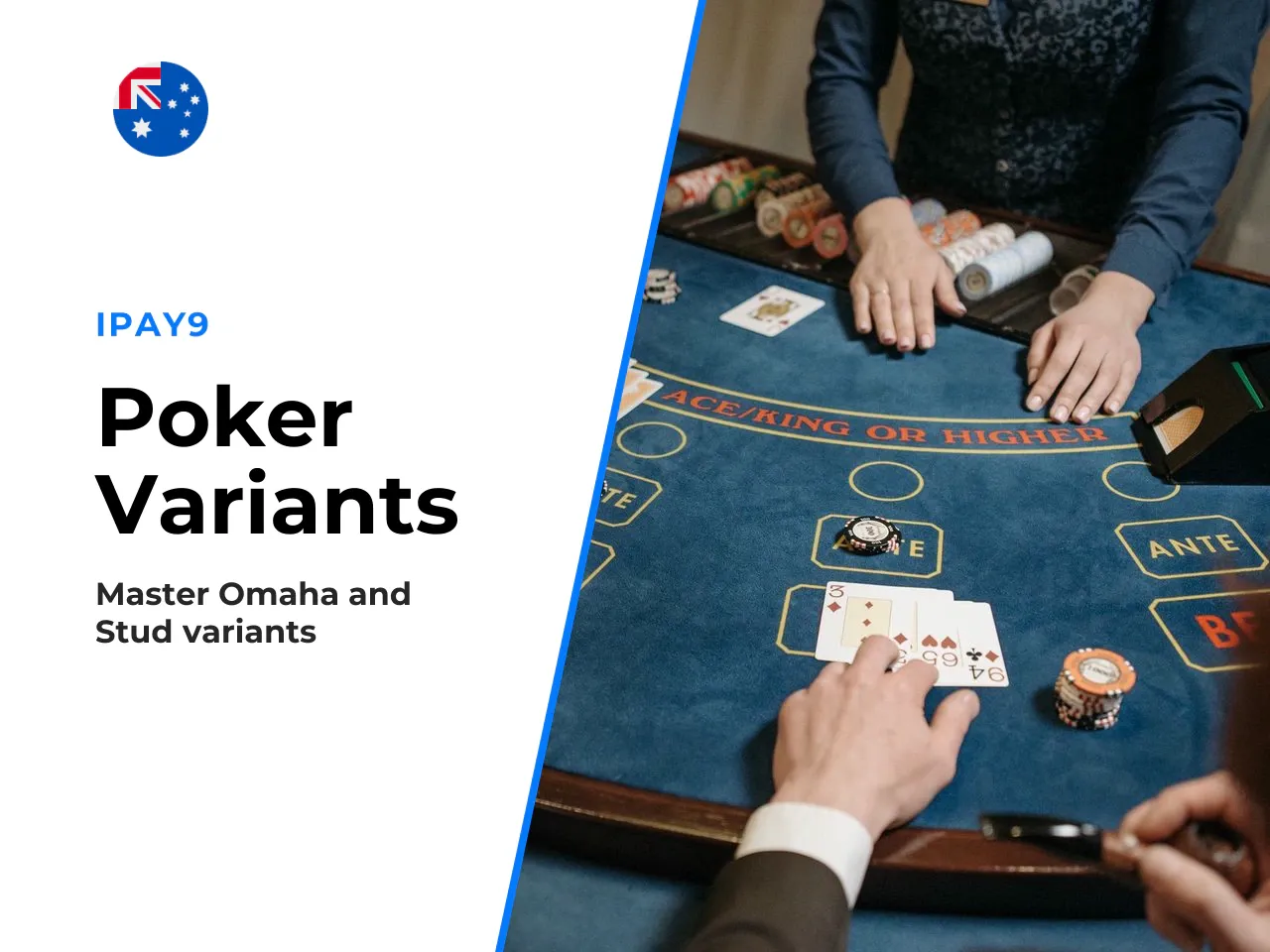
Key takeaway: in 6+ Short Deck, do not rely on your usual hand-ranking memory. Flush over full house is the rule that costs newcomers their first buy-in.
Bomb Pots and novelty formats
Double Board Bomb Pots have become the marquee innovation at crypto-first poker rooms. Every player posts an ante of one to three big blinds, preflop betting is skipped entirely, and two separate flops are dealt. You bet on two boards at once, with the pot usually split between the best hand on each board. The result is enormous pots relative to the blinds and a very high variance experience. Other novelty formats worth knowing: Open Face Chinese and Pineapple OFC cash tables, All-in-or-Fold Sit & Go's, Spin & Go style jackpot SNGs with prize multipliers, and mystery bounty knockout MTTs.
| Criterion | Cash games | MTT | SNG | Spin & Go |
|---|---|---|---|---|
| Blind structure | Fixed | Escalating levels | Escalating, faster | Escalating, hyper-turbo |
| Session length | Any, leave anytime | 4 to 10-plus hours | 20 to 60 minutes | 5 to 15 minutes |
| Chip value | Linear, 1 chip equals 1 cent | Non-linear (ICM) | Non-linear (ICM) | Non-linear, lottery-weighted |
| Variance | Moderate | Very high | Moderate to high | Extreme |
| Bankroll needed | 50 to 100 buy-ins | 200 to 300-plus buy-ins | 100 buy-ins | 200-plus buy-ins |
| Core skill | Postflop EV maximisation | ICM, stack-depth play | Push and fold accuracy | Preflop shove ranges |
| Discipline | Hole cards | Typical structure | Variance | Pace | Learning curve | Traffic at AU peak |
|---|---|---|---|---|---|---|
| Texas Hold'em | 2 | No Limit | Moderate | Medium | Lowest | Excellent |
| PLO (Omaha) | 4 | Pot Limit | High | Fast | Medium | Good |
| PLO5 and PLO6 | 5 to 6 | Pot Limit | Very high | Very fast | Medium to high | Thin |
| Omaha Hi-Lo | 4 | Pot or Fixed Limit | Moderate | Slow | High | Thin |
| Seven-Card Stud | 7 | Fixed Limit | Moderate | Slow | Highest | Very thin |
| 6+ Short Deck | 2 | Ante, No Limit | Very high | Very fast | Medium, rankings change | Moderate |
| Double Board Bomb Pots | 2 to 4 | Ante plus postflop | Extreme | Extreme | Low rules, high strategy | Scheduled |
Text summary of the comparison, for readers who skip tables: Hold'em is the easiest entry point with the best Australian evening traffic. Omaha variants raise both complexity and swing. Stud demands the most memory and is hardest to find. Short Deck and Bomb Pots deliver the biggest pots and the fastest bankroll movement in either direction.
Beginners should default to No-Limit Hold'em 6-max at the lowest available stake, for three reasons: the widest study material, the deepest traffic during Australian evenings, and the lowest variance among no-limit formats. Move to PLO only after your Hold'em win rate is stable, because PLO's variance can hide a losing strategy for tens of thousands of hands.
Most players keep expenditure modest, which suggests many manage to hold spending inside an entertainment budget. The tail of the distribution is long, though, and format choice sits on that tail. Short Deck, PLO6 and Bomb Pots swing bankrolls fastest.
Key takeaway: pick the format your bankroll can survive, not the format with the biggest pots. Variance, not skill, is what removes under-rolled players from the tables.
We did not rank rooms from homepage claims. We created accounts, deposited real money, played hundreds of hands, read the fine print and requested withdrawals. Because most Australian-facing rooms are offshore, a licence badge is not treated as a free pass. Our checks, in order:
"Licensees must provide players with tools to monitor and control their play, including session timers, spend limits and self-exclusion, across all online environments."
Source: UK Gambling Commission, Social Responsibility Code Provision 3.3.1.
Traffic is the single most under-reported metric in poker reviews, and it is the one that decides whether you can actually play. A room with a huge bonus and empty tables is worthless. We tracked table and tournament counts during Australian evening hours and weekends across AEST, ACST and AWST.
What good looks like: 3,000 to 5,000-plus concurrent players during AU-friendly hours, roughly 17:00–22:00 AEST and 17:00–20:00 AWST, which reliably supports Hold'em and Omaha cash games from micro to mid stakes plus MTTs with 100-plus entrants. Below about 1,000 concurrent players, expect to wait for tables outside peak windows.
| Site | Peak AU traffic (17:00–22:00 AEST) | Games offered | MTT formats | Rakeback and rewards | Welcome offer | AU payments | Measured payout time |
|---|---|---|---|---|---|---|---|
| CoinPoker | 5,000+ | Hold'em, PLO, PLO5, PLO6, 6+, Double Board Bomb Pots | Standard, freezeout, re-entry, satellite, KO, PKO | 15% plus CoinRewards | 150% up to US$2,000 (about AU$2,800) | Crypto only | USDT about 45 min |
| Ignition | 3,500+ | Hold'em, PLO, PLO Hi-Lo, FLO, Zone Poker | Standard, freezeout, re-entry, satellite, mystery KO | Ignition Rewards tiers | Up to AU$3,000 split casino and poker | BTC, LTC, cards | BTC about 2 hours, wires several days |
| BCPoker | 3,000+ | Hold'em, PLO, 6+ | Standard, freezeout, re-entry, satellite, All-in-or-Fold | 10% to 50% | 10% first deposit up to US$200 | Crypto | Under 1 hour typical |
| SportsBetting Poker | 2,500+ | Hold'em, PLO, Stud, Pineapple OFC | Standard, freezeout, re-entry, satellite, KO, PKO | Promo-based | 100% up to US$1,000 (crypto) | Crypto, cards | USDT and BTC about 24 hours |
| FullHouse Crypto | 2,000+ | Hold'em, PLO, PLO5, PLO6, 6+ | Standard, freezeout, re-entry, satellite | Up to 20% (VIP) | 250% up to US$2,000 plus 20% instant cash | Crypto | Under 2 hours typical |
| SkyCrown (casino poker) | Not applicable, house games | 30 poker variants including Caribbean Stud, Triple Edge (97.99% RTP), Joker Poker (98.94% RTP) | Not applicable | VIP, invite only | AU$8,000 plus 400 spins over four deposits | PayID, crypto | LTC in 9 minutes |
| GoldenCrown (casino poker) | Not applicable, house games | About 60 live and video poker titles: Caribbean, Three Card, Bonus, Double Bonus, Russian, Six Card, Oasis | Not applicable | Loyalty points | AU$15,000 plus 300 spins, plus 10% crypto | Crypto-led | BTC in 67 minutes |
Traffic figures are our own observed peak-hour counts during testing and fluctuate with online series schedules. Bonus terms change frequently, so always verify on the operator's own page before depositing.
Ignition, best all-round peer-to-peer poker for Australians
CoinPoker, best traffic and format innovation
SkyCrown, fastest measured payout
GoldenCrown, widest casino-poker range
SportsBetting Poker, best for OFC and PKO variety
Who should skip these rooms entirely: anyone who cannot legally or comfortably use offshore, non-Australian-regulated platforms; anyone who needs domestic dispute resolution; anyone who would need credit or borrowed funds to deposit; and anyone currently registered with BetStop or inside a self-exclusion period.
Poker bonuses are not casino bonuses. Three structures matter:
Where casino-side wagering applies, the trap is game weighting. Video poker and casino poker frequently contribute only 5%, so an AU$8,000 package requires an implausible volume if you only play poker titles. Check the max bet while a bonus is active, the max cash-out cap, and whether bonus funds are forfeited when you withdraw.
Behavioural research suggests the most valuable "bonus" a site can give you is honest feedback about your own play.
"Participants described activity statements as a 'reality check', saying the 'big numbers' prompted them to question their behaviour."
Source: BETA activity-statement experiments (2023–2025).
Key takeaway: the two clauses that cost players money most often are bonus game-weighting and max cash-out caps. Screenshot the terms on the day you deposit, because terms change without notice.
Step 1, registration. Use your legal name exactly as it appears on your identity documents. Mismatched names are the single most common cause of blocked withdrawals. Use a unique password and enable two-factor authentication where offered.
Step 2, verification (KYC). Expect to supply photo ID, proof of address such as a utility bill or bank statement dated within three months, and sometimes proof of payment method ownership. Complete this before you need a payout. Hold times of 24 to 72 hours are normal, and source-of-funds requests can extend that. Note that the exact document set and timeline are set by the operator rather than by a universal standard, so read that specific room's policy.
Step 3, responsible-gambling settings. Set a deposit limit, a loss limit and a session-time reminder in the cashier before you play a hand. Pre-commitment is much easier before the first win or loss than after.
Step 4, choosing your first table. Micro stakes exist for exactly this reason:
| Stake | Blinds | Standard 100bb buy-in | Suggested bankroll (50 to 100 buy-ins) |
|---|---|---|---|
| NL2 | $0.01/$0.02 | $2 | $100 to $200 |
| NL5 | $0.02/$0.05 | $5 | $250 to $500 |
| NL10 | $0.05/$0.10 | $10 | $500 to $1,000 |
Start at NL2, 6-max, one table. Add a second table only when you can play the first without ever using your full time bank. Prefer tables with a high average pot size and a high percentage of players seeing the flop, because those loose-passive games are where micro-stakes profit lives.
Content aimed at new players should state plainly that minors must not register, and the Australian evidence explains why that warning cannot be a formality.
"Loot boxes and sports betting were common entry points into online gambling among ACT young adults, with many starting before the age of 18."
Source: ANU study of young adults in the ACT (2023–2025).
Deposit methods available to Australians, in practice:
| Method | Typical minimum | Deposit speed | Withdrawal support | Notes |
|---|---|---|---|---|
| Bitcoin, Litecoin, USDT | AU$10 to AU$25 | 10 to 30 min | Widest and fastest | Network fees apply; LTC and USDT (TRC-20) were cheapest in our tests |
| PayID and Osko | AU$20 to AU$30 | Near instant | Limited, few rooms | Popular locally but supported by a minority of offshore sites |
| Apple Pay, Google Pay | AU$20 | Instant | Rarely for withdrawals | Deposit-only at most rooms |
| Debit and credit card | AU$20 to AU$30 | Instant to 1 hour | Slow, often unavailable | Declines are common; some banks block gambling MCC codes |
| Neosurf and vouchers | AU$10 | Instant | No | Deposit-only |
| Bank or wire transfer | AU$100+ | 1 to 3 days | Yes | Several days out, fees common |
Timed withdrawal results from our testing round: Litecoin 9 minutes (SkyCrown); Bitcoin 67 minutes (GoldenCrown); USDT about 45 minutes (CoinPoker); Bitcoin about 2 hours (Ignition); USDT and Bitcoin about 24 hours (SportsBetting); wire transfers several days. Advertised windows were consistently more pessimistic than reality for crypto, and consistently optimistic for fiat.
Deposits and total spend are not the same number, which is why deposit limits alone are an incomplete safeguard.
"Median deposits over two years were €176.40, well below median total spend of €439.70, pointing to the role of reinvested winnings."
Source: Second Session at the Virtual Poker Table (2023).
Mobile play. Native iOS and Android poker apps in 2026 come close to desktop functionality: multi-tabling, typically up to four tables, cashier access, tournament registration and hand histories. Where no app exists, browser play is often preferable, with nothing to download, nothing to update and no storage requirement. Two cautions. Mobile clients make impulsive play frictionless, and small screens increase misclick risk in fast-fold formats. If you use limits, mobile is where they matter most.
Key takeaway: complete KYC before you win. Crypto is the fastest exit route from an offshore room, and PayID is convenient but supported by only a handful of sites.
The clearest marker of a beginner is how they think about what the opponent holds.
"Beginner poker players try and put somebody on a specific poker hand. Advanced poker players think in terms of ranges."
Source: PokerNews strategy analysis (2024).
A range is the entire spectrum of hands an opponent can hold in a given spot, with frequencies attached. Do not ask "does he have A♥J♥?" Ask instead: on this A-9-4 two-tone flop, after I bet and he check-raises, what does his whole check-raising range look like, including sets, two pair, flush draws, gutshots with backdoor equity, top pair defending and pure air, and what proportion of it beats me right now? You then choose the action with the best expected value against the whole distribution, not against your gut's favourite candidate.
Practical drill: after every session, take five hands you found difficult and write out the opponent's plausible range at each decision point. Then count how many combinations beat your hand versus how many you beat. This one habit converts vague intuition into arithmetic. It is dull work. It is also the cheapest win rate you will ever buy.
Key takeaway, be realistic: nobody has a specific hand in poker, they have a range. Gut feeling and poker strategy do not mix.
Position is information. The later you act, the more you know before committing chips. Opening ranges therefore widen from early position to late position:
| Position | Typical opening range (6-max, NL micro) | Approximate frequency |
|---|---|---|
| Under the gun (UTG) | 77+, AJs+, AQo+, KQs, suited broadways | about 15% |
| Middle position (MP) | 55+, ATs+, AJo+, KJs+, QJs, suited connectors 76s+ | about 19% |
| Cutoff (CO) | 33+, A8s+, ATo+, KTs+, QTs+, J9s+, 65s+ | about 26% |
| Button (BTN) | 22+, A2s+, A8o+, K8s+, KTo+, Q8s+, J8s+, all suited connectors | about 42% |
| Small blind | Tighter than button, raise or fold, avoid flatting | about 28% |
| Big blind | Widest defending range versus late position, tighter versus UTG | 35% to 45% defend |
Tight-aggressive (TAG) means entering fewer pots than the average player, but entering them with the initiative: raise rather than limp, three-bet rather than call, and apply pressure postflop with a coherent betting plan. TAG works at micro stakes because the pool's main leak is playing too many hands from too far out of position.
Ditch your favourite hand while you are at it. Everyone has one, 9♣7♣ perhaps, and it is a mediocre holding. It can be opened from late position in an unopened pot and should almost always be folded from early position. Winning poker is mathematics and cold logic, not superstition.
Key takeaway, be smart: playing too many hands is the most widespread beginner mistake. Fix position discipline before you study anything else.
Your body of study only matters if you apply it at the tables every session. Opening 9♣7♣ from under the gun because you are bored, or drifting into calling-station mode because you are tilted, is not acceptable. Elite players apply the same winning strategy regardless of how they feel or what their recent results look like.
Deviation is allowed, but only with a stated reason. An average player raises 9♣7♣ from early position because he wants something to happen. A strong player raises it there because the table is playing passively and two recreational players sit in the blinds, which makes an ordinarily-folded hand profitable in that specific configuration. If you can produce a well-reasoned argument for the deviation, take it. "Because I feel like it" is not an argument.
Key takeaway, be consistent and reasonable: poker is a long-term game. Do not change strategy after a big win or a big loss, and never deviate without a specific, articulable reason.
The ability to fold an overpair is a clean dividing line between average and strong players. That sick feeling when you hold A♠A♦ and a tight opponent jams the turn on a coordinated board, the crying call that runs into a set again, is information you are choosing to ignore.
The arithmetic: if the pot is $50, the opponent shoves $100, and you need to call $100 to win $150, you need roughly 40% equity. Against a tight player's turn-jamming range on a 9-8-7-J board, made up of sets, two pair, straights and very few bluffs, an overpair often has 15% to 25%. That is a mathematically compulsory fold, not a sigh call. Certain patterns are highly recognisable at lower stakes, where folding the overpair is simply correct.
Key takeaway, aces lose too: starting with the best hand does not guarantee winning the pot. Every professional will tell you the same thing: sometimes you must fold those aces.
Tilt destroys bankrolls, dreams and poker careers. Variance guarantees stretches where correct decisions lose. You will run aces into kings, flop sets and lose, and get outdrawn on rivers for entire sessions. None of that changes the correct decision on the next hand. Tilt does.
Table image feeds into this too. If you have shown down three bluffs in twenty minutes, your value bets get called wider, and that is useful rather than embarrassing, provided you notice it and adjust.
A practical tilt protocol:

Key takeaway: tilt is the only opponent at the table guaranteed to beat you if you let it play. Removing yourself costs one session. Staying can cost a bankroll.
Winning at poker is relative, not absolute. Your edge is your skill minus your opponents' skill minus the rake. A modest player in a soft game earns more than a strong player at a table of regulars.
Selection criteria, in the order we use them: high average pot size relative to the blinds; a high percentage of players seeing the flop, where 35% or more at 6-max is loose; short average stacks and non-standard buy-in amounts, which usually signal recreational players. Opponents auto-topping-up to exactly 100bb with clean, textbook stats are usually regulars. Avoid heads-up tables where an unknown is waiting for you, and leave any table where you are the only one not sitting behind a 200bb stack.
Anonymous tables change the calculus. Without screen names you cannot track individuals, so selection shifts from "who is at this table" to "what does the aggregate pot size tell me".
The only peer-reviewed window into how elite online players actually operate looks closer to trading than to gambling: statistical reasoning, structural risk control, format specialisation and deliberate breaks when distressed.
"Elite players described specialising in particular formats, maintaining strict bankroll management without risking personal funds, and relying on networks of fellow professionals for mutual support."
Source: Newall & Talberg (2023).
Two lessons transfer directly to recreational players. First, specialisation beats breadth: one format studied deeply outperforms five played casually. Second, the money you play with should be structurally separated from living expenses. Professionals maintain a bankroll that is not their rent.
Some players may struggle to hold a disciplined strategy in fast-paced online environments, poker included.
"In ANU models controlling for age and gender, neuroticism, negative urgency, positive urgency and sensation seeking significantly predicted problematic internet use; extraversion was protective."
Source: ANU personality-trait research (2023–2025).
Updated framing, evidence-informed: no poker-specific study directly tests the following pathway, so treat it as a reasoned extrapolation from the internet-use literature rather than a demonstrated poker finding. High negative urgency plausibly translates into chasing losses, over-betting marginal hands or refusing to quit a session after setbacks, because those are the behaviours negative urgency produces in structurally similar online environments. Confirmatory poker research is needed.
What you can do with that, regardless of the evidence gap: if you recognise high impulsivity in yourself, prefer fixed-limit structures, choose tournaments with defined buy-ins over deep-stacked no-limit cash games, set hard deposit limits, and schedule sessions with an alarm rather than playing open-ended.
We could not identify Australian empirical studies published since 2023 that evaluate the impact of strategy coaching, training tools, solvers or AI assistance on poker outcomes. That absence should be reported honestly rather than filled with vendor claims. The practical implications:
Key takeaway: where evidence is missing, say so. Study tools are worth using, but advertised win rate improvements are marketing claims, not research findings.
Health disclaimer: this information is general in nature and does not replace advice from a qualified problem-gambling professional. If you or someone close to you is struggling to control gambling, contact a support service in your region. In Australia, that is Gambling Help Online on 1800 858 858 (24/7) or BetStop, the National Self-Exclusion Register.
Bankroll management is not a regulator-defined standard. It is a money-management rule set that caps stake size relative to available funds. It slows the rate of loss and lets skill express itself over sample size. It does not remove risk.
| Format | Minimum bankroll | Conservative bankroll |
|---|---|---|
| NL cash games (6-max) | 50 buy-ins | 100 buy-ins |
| Pot Limit Omaha | 100 buy-ins | 150-plus buy-ins |
| Single-table SNG | 50 buy-ins | 100 buy-ins |
| Multi-table tournaments | 200 buy-ins | 300-plus buy-ins |
| Spin & Go and hyper formats | 200 buy-ins | 400 buy-ins |
| 6+ Short Deck, PLO6, Bomb Pots | 150 buy-ins | 250-plus buy-ins |
Professional guidance commonly sets a 50 buy-in minimum for lower-variance play and 100 buy-ins as a stronger buffer. The range exists to survive downswings, not to increase expected profit.
Pre-commitment tools work, and the Australian evidence base for them has strengthened.
"The NSW Gambling Survey 2024 included a randomised controlled experiment on deposit limits among online sports and race bettors, showing that structured limit options increase uptake."
Source: NSW Gambling Survey 2024, Central Queensland University and NSW Responsible Gambling Fund.
Australia's National Consumer Protection Framework for Online Wagering sets a ten-point minimum consumer-protection package for licensed wagering providers, including activity statements and deposit limits. It remains the most useful domestic benchmark for judging any poker platform you use, licensed here or not.
Guidance from specialist organisations converges on the same three controls:
⚠️ Responsible poker checklist
- Set limits before your first hand: deposit limit, loss limit, session-time reminder. Pre-commitment is the single best-supported control.
- Review your own numbers monthly. Monitoring total activity reduces betting intensity.
- Never gamble with borrowed money, credit, or funds allocated to rent, bills or food.
- Keep poker money structurally separate from everyday finances, as professional players do.
- Use a stop-loss and honour it: three buy-ins in cash, or a fixed clock.
- Do not chase losses by moving up in stakes.
- Take a cooling-off period if you have played longer than planned twice in a week.
- Register with BetStop if you decide to stop. It blocks licensed Australian operators from contacting or accepting you.
- Talk to someone. Gambling Help Online: 1800 858 858, 24/7, free and confidential.
The activity-monitoring recommendation rests on Australian experimental work.
"BETA experiments with two activity-statement prototypes, one graphical and one tabular, found reduced betting among participants who received activity summaries compared with a control group."
Source: BETA activity-statement experiments (2023–2025).
Poker decisions can have long-term impacts beyond the immediate session, and Australian measurement is now catching up with that reality.
"The NSW Gambling Survey 2024 measured, for the first time, harm experienced by people close to gamblers and harm from gambling that occurred more than twelve months earlier."
Source: NSW Gambling Survey 2024.
| Service | Contact | What it does |
|---|---|---|
| Gambling Help Online | 1800 858 858 or gamblinghelponline.org.au | 24/7 free counselling, chat and email support |
| BetStop | betstop.gov.au | National Self-Exclusion Register, one form blocks licensed Australian wagering operators |
| Lifeline | 13 11 14 | 24/7 crisis support |
| Financial Counselling Australia | 1800 007 007 | Free debt and financial counselling |
| Gambler's Help (VIC) | 1800 858 858 | State-based face-to-face counselling |
Key takeaway: limits set in advance work better than willpower applied in the moment. If reading your own monthly totals makes you uncomfortable, that discomfort is the signal. Act on it.
Four free tools do most of the heavy lifting for new players:
How we tested. Real accounts, our own money, at least 500 hands per site during Australian peak hours, full KYC completion, then a timed withdrawal on every platform. We recorded licence jurisdiction and corporate entity, RNG audit evidence, published payout terms, table counts and tournament counts by hour, bonus release mechanics and game weighting, support response times on a genuine query, and the exact responsible-gambling tools available inside each client. Where a room's advertised claim conflicted with our measurement, we published the measurement.
How we scored. Poker selection and traffic depth, trust and safety with real-money testing weighted above trust logos, bonus and rakeback value modelled against realistic rake generation, banking and payout speed, mobile experience, and responsible-gambling tooling. Offshore licences reduce the maximum achievable trust score regardless of other strengths.
Sources cited in this guide. Australian Government response to the Environment and Communications References Committee, Online Poker report (2023–2025); Interactive Gambling Act 2001 (Cth); National Consumer Protection Framework for Online Wagering, Australian Government Department of Social Services (2021); ANU study of young adults in the ACT (2023–2025); ANU personality-trait research on problematic internet use (2023–2025); NSW Youth Gambling Study (2020); NSW Gambling Survey 2024, Central Queensland University and NSW Responsible Gambling Fund; BETA (Behavioural Economics Team of the Australian Government) online wagering and activity-statement experiments (2023–2025); Second Session at the Virtual Poker Table (2023); Newall & Talberg, qualitative study of elite online poker players (2023); Luck of the draw? Inside Western Sydney's gambling harm epidemic, Centre for Western Sydney (2023–2025); YouGov Online Poker Participation Report (2024); UK Gambling Commission Social Responsibility Code Provision 3.3.1; Gambling Act 2005 (UK); WHO ICD-11 (gambling disorder), World Health Organization, https://icd.who.int/; analysis of India's Promotion and Regulation of Online Gaming Act (2023–2025); BeGambleAware and GamCare responsible-gambling guidance. Where a publisher had not released a stable public URL at the time of writing, we named the publication and year rather than link to a secondary aggregator.
Editorial policy. Operator information, including bonuses, limits, payment methods and traffic, changes frequently. We re-test our top rooms quarterly and date every update at the top of the page. We do not accept payment for ranking position, and any commercial relationship does not alter our measured results. Promotions described here were accurate at the time of testing, so always verify current terms on the operator's own page before depositing.
Combined disclaimer. This article is general information about poker rules, formats, strategy and industry practice. It is not legal, financial or medical advice. Real-money poker online may be prohibited or restricted where you live, offshore operators are not covered by Australian consumer protection, and gambling can cause financial and psychological harm. Strictly 18+, and 21+ in some jurisdictions. If gambling is causing you problems, contact Gambling Help Online on 1800 858 858 or register with BetStop.