Table of Content

Plinko: Play Online Free or for Real Money

Last updated: April 2026 · Reviewed by: Claire Bennett, Senior Casino Content Editor (12+ years reviewing iGaming software, RTP documentation and operator terms)

«Before you look at any headline multiplier or welcome bonus, inspect the underlying game rules, payout friction and local compliance. A transparent review evaluates terms, volatility and player protections first.» — Claire Bennett, Senior Casino Content Editor

Provider

BGaming

RTP

97%

Volatility

High

Max win

x10,000

Plinko Play Online Free or for

The Short Version

  • What it is:Plinko is a casual, arcade-style RNG casino game (not a live-dealer product) in which a ball drops through a grid of pegs and lands in a cell carrying a fixed payout multiplier.
  • RTP:Provider documentation lists roughly 96%–99% theoretical RTP (Spribe ~97%, BGaming 99%, Hacksaw ~96%–98%). These are vendor-published figures, not independently audited numbers, so always confirm them in the game's help panel.
  • What you control:stake size, row count (8–16), risk tier (Low/Medium/High), auto-drop caps and session limits. What you cannot control: the trajectory of the ball or the long-run house edge.
  • Maximum multipliers:up to 1000x on 16 rows at High Risk in several releases; central cells routinely return less than your stake (0.2x–0.9x).
  • Legality in Australia:under the Interactive Gambling Act 2001 (Cth), offering online casino-style games to people located in Australia is prohibited, and the ACMA blocks non-compliant offshore sites.
  • Biggest practical risk:round speed. Auto-drop can resolve dozens of wagers per minute, compounding losses far faster than reel-based slots.
  • Support:National Gambling Helpline 1800 858 858 (24/7) and the BetStop national self-exclusion register.
The Short Version

Plinko has travelled a long way from a 1983 television segment on The Price Is Right to one of the most visible casual arcade titles in modern online casino lobbies. Adapted for digital platforms by developers such as Spribe, BGaming, Hacksaw Gaming and Stake Originals, the modern plinko game swaps physical plastic discs for digital spheres bouncing through a grid of pegs. The core mechanic stays visually intuitive. What changes online is the control panel: adjustable row counts, variable risk levels and cryptographic fairness verification.

Whether you are testing a plinko demo with virtual credits or weighing up plinko real money options, the useful preparation is mathematical rather than tactical. Multiplier distribution, house edge and local regulatory boundaries decide far more than any drop pattern you think you have spotted.

Plinko has travelled a long way

In two sentences: Plinko is an arcade-style wagering game where a dropped ball bounces through pegs into a cell with a fixed multiplier. Its appeal comes from second-long rounds, visible randomness and direct player control over volatility settings.

Plinko is an arcade-style online wagering game in which a dropped ball cascades through a triangular field of obstacles (pegs) and lands in one of several lower cells, each assigned a specific payout multiplier. The pull of plinko games lies in the combination of simple gameplay, instant outcome feedback and direct user control over volatility settings. Unlike traditional online slots with layered paylines and multi-stage bonus rounds, plinko online presents a transparent probabilistic model where the ball's path is visible in real time.

The popularity of the plinko casino format comes down to a handful of design factors:

What Is the Plinko Game and

The commercial scale behind this category is substantial, which explains why casual RNG titles like Plinko are pushed so hard by offshore operators:

From TV studio to iGaming lobby, the evolution of Plinko:

Note: BGaming's Plinko is a casual arcade / RNG title, not a live-dealer casino game. Some review sites still get that distinction wrong.

The Plinko Board: Balls, Pegs and Winning Cells

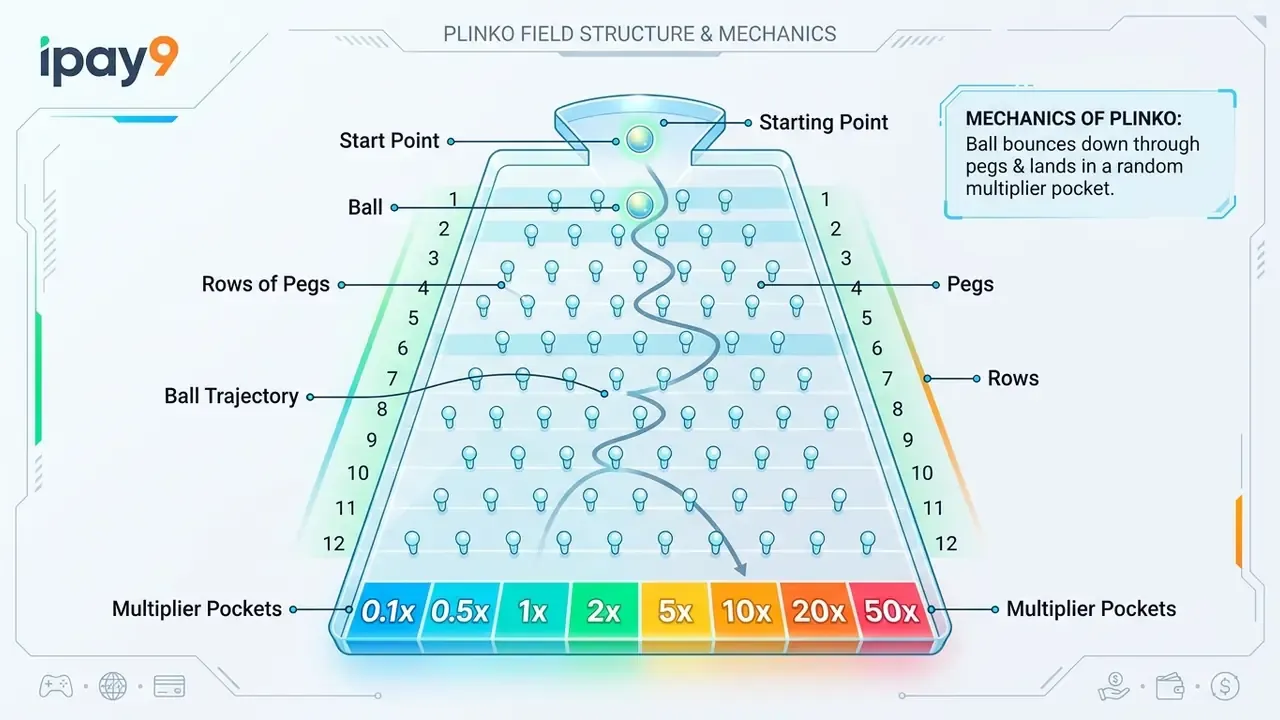
The Plinko playing board is a vertical or slanted triangular grid filled with horizontal rows of obstacle pins, known as pegs. At the top sits the drop zone, from which digital balls are released either one at a time or in rapid sequences. As a ball descends under simulated gravity, every collision with a pin forces a random left or right deflection and rewrites its path downward.

At the base of the pegboard sits a row of terminal landing slots, each carrying a specific payout multiplier. Multipliers in the central cells usually sit below 1.0x, which returns only part of the bet, while outer edge cells hold substantially higher values. Published operator paytables for 16-row boards show maximum edge multipliers of up to 1000x at High Risk (see the full payout matrix below), while central cells on the same board can pay as little as 0.2x. Because central trajectories need fewer specific deflections, balls land in the middle far more often, mirroring a classic binomial probability distribution.

The Plinko Board Balls, Pegs and

Anatomy of the board (annotated reference):

ElementLocation on the boardFunction
Drop zoneTop apexRelease point for every ball; identical for all drops
PegsRows 1 to N (8–16)Each collision forces a random left/right deflection
Central cellsBottom middleHighest hit frequency, multipliers usually below 1.0x
Intermediate cellsBetween centre and edgeModerate frequency, multipliers around 1.0x–5x
Edge cellsBottom extremesLowest hit frequency, highest multipliers (up to 1000x)

How Plinko Works: Mechanics, Multipliers and Risk

The game mechanics of plinko online rely on digital Random Number Generators (RNG) or cryptographic Provably Fair algorithms to determine the path and final landing slot of every dropped ball. Each pin deflection is an independent probabilistic event, meaning the previous drop tells you nothing about the next one. The payout for the round is calculated instantly: the wager is multiplied by the multiplier value of the destination cell.

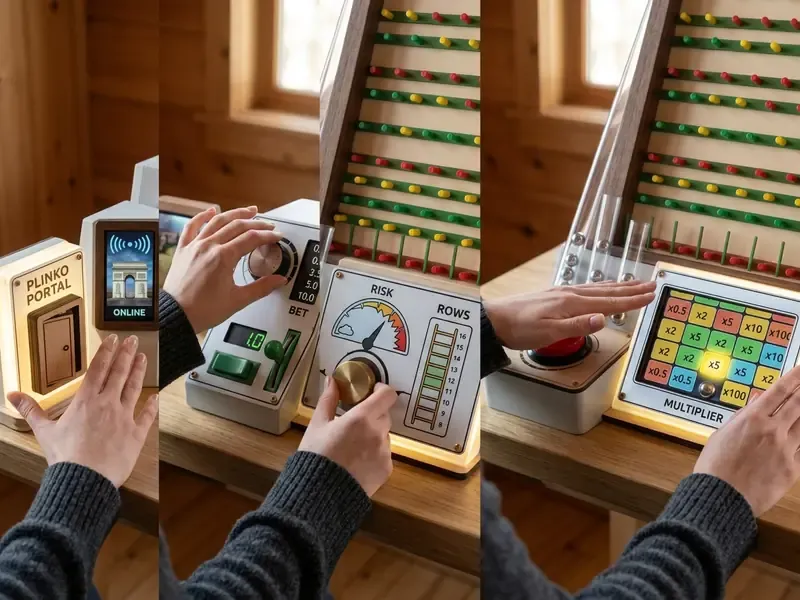
Modern digital versions do not lock you into one board layout. Developers expose two variables directly, the number of row lines and the risk tier, and both reshape the volatility and payout spread of the game.

How Plinko Works Mechanics, Multipliers and

Rows and Risk Levels in Plinko

Adjusting the number of rows (typically 8 to 16 lines) changes the board geometry and the count of landing slots at the bottom of the field. More rows means a longer journey for the ball, more deflection points and a wider multiplier gap between central and peripheral cells.

Three risk settings are usually available:

  1. Low Risk: multiplier values cluster tightly around 1.0x. Outer cells stay modest (roughly 5x to 16x), but central loss coefficients are softened (0.5x to 0.9x), giving lower volatility and steadier session stability.
  2. Medium Risk: a balanced distribution with moderate central reductions offset by outer payouts reaching double and low triple digits.
  3. High Risk: extreme variance. Central slots return a minimal 0.2x, while outer edge cells offer maximum theoretical wins of 500x to 1000x the stake.

Full payout range matrix (rows × risk tier). The table below consolidates the published multiplier ranges used across mainstream Plinko releases, so you can see exactly how geometry and risk interact before committing a single dollar:

Rows and Risk Levels in Plinko
RowsLow Risk (min – max)Medium Risk (min – max)High Risk (min – max)
80.5x – 5.6x0.4x – 13x0.2x – 29x
90.7x – 5.6x0.5x – 18x0.2x – 43x
100.5x – 8.9x0.4x – 22x0.2x – 76x
110.7x – 8.4x0.5x – 24x0.2x – 120x
120.5x – 10x0.3x – 33x0.2x – 170x
130.7x – 8.1x0.4x – 43x0.2x – 260x
140.5x – 7.1x0.2x – 58x0.2x – 420x
150.7x – 15x0.3x – 88x0.2x – 620x
160.5x – 16x0.3x – 110x0.2x – 1000x

Read the matrix as a variance dial, not a value dial. Moving from 8 rows at Low Risk to 16 rows at High Risk multiplies your theoretical ceiling by more than thirty times. It also drags the most frequently hit central cells down from 0.5x to 0.2x, so the typical drop hands back one fifth of the stake. The long-term house edge does not improve at any setting. Not at any of them.

Impact of settings on a A$10 stake (illustrative):

SettingTypical central-cell returnRealistic upper bandPractical effect on bankroll
8 rows / LowA$5.00 – A$9.00A$56Longest session length, smallest swings
12 rows / MediumA$3.00 – A$9.00A$330Balanced variance, moderate depletion rate
16 rows / HighA$2.00A$10,000Fastest depletion; edge hits are statistically rare

RTP and Randomness of Outcomes

The theoretical Return to Player (RTP) published by developers for standard plinko games generally sits between 96% and 99%, depending on the studio and the platform configuration. A caveat worth holding onto: these figures come from vendor documentation rather than independently published audit reports, and some operators reconfigure RTP per market. Treat the number in the game's help panel as the authoritative value for the version you actually opened. An RTP of 98% indicates that, across millions of theoretical drops, the game engine keeps an average house edge of 2% and returns 98% of total wagers to the player base.

RTP is a long-term statistical aggregate, though, not a promise for your session. Short-term outcomes are driven by high volatility, so a run of low-multiplier drops or one rare outer-cell hit can both happen inside a few minutes.

RTP and Randomness of Outcomes. The

«Online gamblers were almost five times more likely to experience moderate or high risk of gambling harm than those who did not gamble online.» — NSW Gambling Survey 2024, representative sample of 10,000 NSW residents. https://www.nsw.gov.au

That elevated risk profile matters more in Plinko than in most casino verticals, because the format compresses wagering decisions into seconds. One auto-drop configuration can resolve more wagers in five minutes than an hour of table play.

Fact check / rules verification: Official provider documentation from Spribe and BGaming confirms that their Plinko titles use cryptographic Provably Fair technology. The mechanism lets players independently verify the randomness of every round by cross-referencing server seeds, client seeds, nonces and cryptographic hashes (SHA-256). The theoretical RTP (96%–99%) stays mathematically fixed whether a player selects 8 or 16 rows. Selecting High Risk shifts the distribution variance without altering the long-term house edge.

How to Play Plinko Online: Step by Step

Starting a round of plinko play is a short sequence of interface choices. Follow these steps to configure and launch a session correctly:

  1. Select a verified platform. Use a licensed operator or an informational demo portal running genuine software from certified developers. Confirm the developer name appears in the game info panel; unnamed clones are a red flag.

  2. Set the wager amount. Define your base bet per drop with the +/− controls or the manual input field, keeping the stake inside your pre-set budget.

  3. Configure board rows. Choose the number of active peg lines (usually 8 to 16 rows) in the rows selector, normally in the left-hand settings column on desktop and behind a gear icon on mobile.

  4. Choose the risk tier. Pick Low, Medium or High from the risk dropdown, directly above or below the rows selector, according to the volatility you are willing to accept.

  5. Release the ball. Click the manual drop button (labelled Bet, Play or Drop), or switch to the Auto tab to launch a set number of sequential balls with loss and win stop-triggers.

  6. Verify the payout. Watch the final landing cell; the multiplier is applied to your stake and credited to your balance, and the coefficient is logged in the round-history strip beside the board.

Interface orientation checklist (before your first real-money drop):

  • Locate the rows selector and confirm it changes the board geometry on screen.
  • Locate the risk selector and watch the bottom cell values change as you switch tiers.
  • Open the Auto tab and confirm you can set a number of drops, stop on loss and stop on win value.
  • Open the help/info panel and note the stated RTP and maximum multiplier.
  • Locate the round history / record table so you can review recent coefficients at any time.

Plinko Demo and Free Play: How to Test the Format

A plinko demo lets you experience the full mechanics of the game on virtual play credits instead of a deposit. Operating as a plinko free utility, demo mode replicates the same interface, board physics, row adjustments and risk toggles found in real-money releases. Most developer-hosted demos (BGaming's included) run in-browser without registration; operator-hosted demos may ask for an account before the free version unlocks.

Free demo modes serve a few practical purposes:

  • Testing how a shift from 8 to 16 rows changes the visual spread of drops.
  • Observing how often the central cells land compared with the peripheral ones across risk settings.
  • Getting comfortable with auto-play controls, drop speed toggles and stop-triggers without financial risk.
  • Timing how long a fixed virtual bankroll survives at each risk tier, which is a genuinely useful reality check.
Plinko Demo and Free Play How

«Demo modes provide essential mechanical familiarity, but they remove the psychological friction of financial risk. Testing volatility in a free environment should be treated as an educational step, not a predictor of monetary gain.» — Claire Bennett, Senior Casino Content Editor

Plinko Demo vs Real Money: What Actually Changes

A certified plinko demo uses the identical Random Number Generator (RNG) architecture and RTP model as the real money version. The differences sit elsewhere: in player psychology, monetary exposure and operational friction.

Feature / dimensionPlinko demo modePlinko real money mode
Currency usedVirtual fun credits (indefinite refill)Actual fiat or cryptocurrency balance
Financial riskZero financial exposureDirect risk of partial or total loss of stake
Mathematical engineIdentical RNG & Provably Fair algorithmIdentical RNG & Provably Fair algorithm
Player behaviourHigher tendency toward extreme risk settingsRequires strict bankroll discipline and limits
Withdrawal eligibilityNone (payouts are non-transferable)Subject to casino withdrawal terms & KYC checks

«Young people who played simulated gambling games were 40% more likely to spend real money on gambling later in life.» — Australian Institute of Family Studies, cited in the Australian Government video game classification reform (2023). https://www.aifs.gov.au

«Simulated gambling is consistently associated with subsequent monetary gambling participation, including transitions from adolescence into early adulthood.» — Convergence of Simulated and Monetary Gambling: Systematic Review of 181 empirical studies, New Zealand Ministry of Health with Australian university researchers (2023). https://www.health.govt.nz

Anyone moving from demo to monetary mode should recognise one habit trap. Unlimited virtual balances normalise behaviour, high stakes, maximum risk, long auto-drop sequences, that no real bankroll can absorb.

Plinko Real Money: Stakes, Payouts and Potential Wins

Please note: this information is general in nature and does not replace advice from a lawyer or a responsible gambling professional. Online casino games, including Plinko, may not be lawfully supplied to people located in Australia under the Interactive Gambling Act 2001 (Cth).

In Australia, interactive gambling is governed by the Interactive Gambling Act 2001 (Cth), enforced by the Department of Infrastructure, Transport, Regional Development, Communications and the Arts alongside the Australian Communications and Media Authority (ACMA). Under federal law, offering online real-money casino games, including online slots, roulette and digital arcade products like Plinko, to individuals located within Australia is prohibited. Note the direction of the rule: the prohibition binds operators, not individual players. The practical consequence for players is that ACMA actively issues website-blocking requests against illegal offshore operators, and a blocked site can drop out of reach mid-session.

In Australia, interactive gambling is governed

«ACMA continues to request the blocking of illegal offshore gambling websites offering prohibited casino services to Australians.» — ACMA, Interactive Gambling Sector Developments Report (2024). https://www.acma.gov.au

Playing plinko real money rounds means depositing actual funds with a legal, licensed operator in a jurisdiction where such supply is lawful. In that format every ball carries financial weight, and the final landing slot decides whether the round produces a net gain, a partial recovery or a complete loss of the bet. If you are comparing licensed online casino operators, check the licence status against the regulator's public register before depositing, not against a badge image in the casino footer.

What happens if a site is blocked while you hold a balance? Blocking restricts access at the ISP level. It does not transfer, freeze or protect your funds, and Australian regulators cannot recover money from an unlicensed offshore operator on your behalf. That is exactly why balance size, withdrawal thresholds and KYC completion status deserve more attention than promotional headlines.

Playing plinko real money rounds means

Minimum and Maximum Bet

Minimum and maximum stake boundaries in plinko casino titles are set by software vendors and then by individual platform operators. Entry-level wagers commonly start as low as A$0.10 per drop, though some operator configurations start at A$1.00, while maximum single-ball caps can reach A$100 or higher.

Provider configurationTypical minimum betTypical maximum bet
Spribe Plinko~A$0.10 per drop~A$100 per drop
BGaming Plinko~A$0.10 per drop~A$100 per drop
Hacksaw Gaming Plinko~A$0.10 per dropOperator-dependent (often A$100+)

Because plinko play allows rapid sequential drops, including automated modes launching dozens of balls per minute, small individual wagers accumulate into serious total spend over a short window. A A$1 stake at 60 drops per minute equals A$60 of turnover per minute; at a 2% house edge, that is roughly A$1.20 of expected loss every minute before variance even enters the picture. Strict per-drop stake limits and auto-drop caps are therefore the practical control point.

How Plinko Payouts Are Calculated

Payouts in plinko online follow one simple calculation:

Final Payout = Initial Bet Amount × Cell Multiplier

Three worked examples:

  • Example A (central cell, Low Risk):a player wagers A$100 on a 12-row board at Low Risk. The ball lands in a central slot carrying 0.8x. The payout is A$100 × 0.8 = A$80, a net loss of A$20.
  • Example B (peripheral cell, High Risk):a player wagers A$50 on a 16-row board at High Risk. The ball lands in an outer edge slot carrying 120x. The payout is A$50 × 120 = A$6,000, a net profit of A$5,950.
  • Example C (worst case, High Risk):a player wagers A$50 on a 16-row board at High Risk and lands the most frequently hit central cell at 0.2x. The payout is A$50 × 0.2 = A$10, a net loss of A$40 on a single drop.
How Plinko Payouts Are Calculated. Payouts

Example C is the one most players underestimate. On a High Risk 16-row board, the statistically dominant outcome is a return of one fifth of the stake. The 1000x edge cell exists to justify that trade-off, not to offset it.

Legal disclaimer: Real-money interactive gambling is restricted to legal jurisdictions and legal age requirements (18+ in Australia). Online casino-style gambling services are prohibited from being offered to Australian residents under the Interactive Gambling Act 2001. Information in this guide is for educational and comparative review purposes only and is general in nature; it is not legal or financial advice. Gambling involves substantial financial risk, including the complete loss of deposited capital. Review local laws and operator compliance terms before participating.

Plinko Bonuses, Payments and Withdrawal Friction

Most real-world Plinko complaints originate in payments and verification, not in the game maths. The overview below describes how deposits, verification and bonus wagering are typically structured at offshore operators serving English-speaking markets. It is provided for informational and comparative purposes only, and does not encourage use of services that may not lawfully be supplied to people located in Australia.

Typical deposit and withdrawal characteristics:

MethodDeposit speedTypical withdrawal speedNotes and friction points
PayID / instant bank transferInstant to ~30 min1–3 business daysPopular locally; often subject to daily withdrawal caps and full KYC before first payout
Visa / MastercardInstantFrequently not supported for payoutsWithdrawals commonly rerouted to bank transfer or crypto; card gambling blocks are common
Cryptocurrency (BTC, ETH, USDT, LTC)10 min – 1 hour (network dependent)Often within 1–24 hoursFastest payout route at most Plinko-heavy platforms; network fees and price volatility apply
Neosurf / prepaid vouchersInstantNot available (deposit-only)Requires an alternative payout method to be nominated and verified
eWallets (Skrill, Neteller-type)Instant24–48 hoursFrequently excluded from bonus eligibility in the terms

KYC and verification. Expect identity checks (photo ID, proof of address, sometimes a payment-method screenshot) before the first withdrawal is released. Verification is the single most common cause of payout delay, and it is often triggered only when you request a withdrawal, which is why large High Risk wins can sit pending for days. Upload documents right after registering, not after winning.

Withdrawal limits. Daily, weekly and monthly caps are standard, commonly A$2,000–A$10,000 per week at mid-tier platforms. A 1000x hit on a A$100 stake can exceed a weekly cap several times over, so the payout arrives in instalments across weeks.

Bonus wagering and Plinko contribution, read this before claiming anything. Casual arcade and instant-win titles are almost always the worst games for clearing a wagering requirement:

  • Plinko and similar arcade games typically contribute 0%–5% toward bonus wagering, against 100% for most video slots.
  • Some terms explicitly exclude Provably Fair or originals-style titles from bonus play altogether, and staking bonus funds on an excluded game can void both the bonus and any winnings from it.
  • Maximum bet limits while a bonus is active (commonly A$5–A$7 per round) apply per drop, and auto-drop sequences can breach them without you noticing.
  • High-RTP configurations (98%–99%) are often capped or excluded from promotions precisely because the house edge is thin.

Practical rule: if your intention is to play Plinko, consider playing it with cash funds only and keeping bonuses for slot sessions. Cross-check the game contribution table in the bonus terms before your first deposit.


KYC and verification. Expect identity checks

How to Choose a Plinko Casino and the Right Version of the Game

When you inspect plinko casino options and compare software offerings, put regulatory compliance, verified software integrity, clear withdrawal terms and accessible responsible gambling tools ahead of headline promotions. The best offer on paper is often the one with the tightest restrictions buried in the terms.

Our editorial team ran compliance checks on offshore software releases to verify RTP disclosures and payment processing rules. We cross-referenced developer game files against published operator terms to surface discrepancy risks, including cases where an operator advertised a 99% RTP build while serving a reconfigured lower-RTP version. That structured review process, documented in our iGaming platform review methodology, produced the evaluation criteria we use to isolate high-risk platforms and highlight operators with transparent terms and verified RNG certification.

How to verify an offshore licence in four steps:

  1. Find the licence number and issuing authority in the site footer (Curaçao, Malta Gaming Authority, Anjouan and similar).

  2. Open the regulator's own public register, never the link supplied by the casino, and search the number.

  3. Confirm the registered corporate entity on the licence matches the entity named in the operator's terms and conditions.

  4. Check whether the licence covers the specific domain you are using; multi-brand groups frequently run unlicensed mirror domains.

Plinko Version Comparison

Parameter / featureSpribe PlinkoBGaming PlinkoHacksaw Gaming Plinko
Developer / providerSpribeBGamingHacksaw Gaming
Theoretical RTP~97.00%98.00%–99.00%~96.00%–98.02%
Row range options12, 14 or 16 rows8 to 16 customisable rows8 to 16 customisable rows
Maximum multiplierUp to 555xUp to 1000xUp to 1000x
Provably Fair supportYes (cryptographic)Yes (cryptographic)Yes (cryptographic)
Auto-play featureYes (with colour/risk filters)Yes (advanced limits, Manual + Auto modes)Yes (round count caps)
Round history / record tableYesYes (dedicated record board)Yes
Mobile optimisationNative HTML5 / PWANative HTML5Native HTML5
Game typeCasual arcade / RNGCasual arcade / RNG (released 28 Jan 2019)Casual arcade / RNG

Beyond those three studios, mainstream suppliers have moved into the category. Pragmatic Play (Olympus Plinko), BetSoft (Plinko Rush), Evoplay (Plinko Bonanza), Design Works Gaming (Plinko Blitz), Turbo Games, SmartSoft Gaming and Belatra all publish pegboard titles with their own paytables and bonus layers. Entry thresholds differ too: BGaming and Spribe builds commonly start near A$0.10 per drop, while some operator-configured versions lift the floor to A$1.00. On a small bankroll planning long auto-drop sessions, that gap decides everything.

Which Features to Check Before You Play

Before you commit funds or settle on a plinko game, confirm these operational features exist:
  • RTP disclosures:the exact theoretical RTP should be documented in the game's help panel (ideally 97% or higher) and should match the developer's published figure.
  • Provably Fair verification:cryptographic seed verification (server seed, client seed, nonce, SHA-256 hash) should be reachable inside the gameplay interface.
  • Auto-drop control caps:automated play should allow binding loss limits, single-win stop triggers and a maximum number of drops. Auto-drop without stop-triggers is the most dangerous configuration in the entire format.
  • Live record table (round history):a built-in statistics board logging the coefficients of the last 50–100 drops. It shows the real dispersion of your session against the theoretical central-cell frequency, which works as a discipline tool. Past coefficients never influence the next drop.
  • Real-time RTP / hot-and-cold indicators:some providers surface live payout performance data. Treat these as transparency and session-tracking aids, not predictive signals; every drop stays statistically independent.
  • Manual vs Auto bet modes:manual mode forces a decision before every wager, which slows turnover noticeably compared with Auto.
  • Mobile responsiveness:the HTML5 interface should adapt cleanly across plinko mobile browsers, with no lag and no mis-registered taps on the stake controls.
  • Responsible gambling tools:deposit limits, session time-outs, reality checks and self-exclusion should sit within two clicks of the game lobby.
Which Features to Check Before You

The pegboard concept has splintered into dozens of branded releases. The titles below are the versions most commonly encountered in international lobbies, with vendor-published RTP figures:

How to read this table: high RTP and a high maximum multiplier rarely sit together. Plinko XY's ~99% RTP arrives with a 16x ceiling; Olympus Plinko's 1000x ceiling arrives with a lower RTP and much deeper central losses. Pick the trade-off on purpose instead of chasing the biggest number on the page.

Plinko Strategy: What You Can Control and What You Cannot

Hunting for a guaranteed plinko strategy is a common instinct, and the maths of independent probability closes it off quickly. Every pin collision is decided by randomised digital algorithms, so no betting sequence and no drop timing can influence the trajectory of a ball.

The decisive point is the linearity of expected value. For a sequence of independent wagers each carrying a fixed negative expectation, total expected value is simply the sum of the individual expectations. No staking pattern, progressive, regressive or random, converts a negative-expectation game into a positive-expectation one. Staking systems redistribute variance and shift the probability of ruin. That is all they do.

Progressive systems such as the Martingale (doubling the wager after a losing drop) are mathematically flawed in any game with a house edge and a fixed maximum stake:

  • The Martingale flaw: in Plinko, central cells often return partial stakes (0.5x or 0.7x) rather than a clean zero, so a "loss" is fractional and a doubled stake does not recover it neatly. Doubling after every sub-1.0x return escalates bankroll burn exponentially, hitting table maximum caps or draining the balance during extended low-multiplier streaks. After n consecutive losing drops, cumulative exposure grows as 2ⁿ − 1 units, a curve no finite bankroll survives.
  • Negative expected value (EV): no adjustment to bet sizing turns a negative mathematical expectation into a positive long-term outcome.
Plinko Strategy What You Can Control

Stake Management and Risk Selection

The only things a player genuinely controls in Plinko are base stake size, row layout, risk tier, session duration and overall bankroll boundaries. Sustainable play rests on structured risk management, not on outsmarting the game engine.

Key principles:

  1. The 1% bankroll rule: keep individual ball wagers at or below 1% of your total session budget.
  2. Matching risk to goals: choose Low Risk with 8–10 rows if you want low variance and a longer session; choose High Risk with 16 rows only if you accept rapid bankroll depletion in exchange for rare outer-multiplier potential.
  3. Session stop-losses: set rigid loss thresholds in advance (for example, stopping if session funds fall by 20%) and encode them into the auto-drop stop-on-loss field rather than trusting willpower.
  4. Flat betting (fixed-percentage staking): hold the stake at 1%–2% of the current balance regardless of the previous outcome. In a game with fixed negative expectation this is the most durable model available. It cannot create an edge, but it maximises the number of rounds a bankroll supports and removes escalation risk.
  5. Anti-Martingale (reverse Martingale): double the stake only after a winning drop (a multiplier above 1.0x) and revert to base after any loss. This rides fortunate clusters without exposing the bankroll to exponential escalation during losing streaks, though the eventual reversal lands on your largest stake, so a strict win-cap (revert after two consecutive uplifts) is essential.
  6. Fixed-bet discipline: wagering the same amount every round is safer and produces smaller swings. It will not produce large wins quickly, which is rather the point.
  7. Split your bankroll into sessions: never stake a whole bankroll in one sitting; divide it into pre-defined session budgets and treat each as a closed decision.
Stake Management and Risk Selection. The

«Betting sessions in which the ability to bet anytime and anywhere was prioritised were more likely to involve impulsive wagering and higher short-term harm.» — Ecological Momentary Assessment study of situational features of smartphone betting, 267 participants across 1,378 sessions, Australia (2023–2024). https://www.responsiblegambling.vic.gov.au

Strategy comparison at a glance:

ModelStake behaviourEffect on varianceRisk of ruinChanges house edge?
MartingaleDoubles after a lossExtremeVery highNo
Anti-MartingaleDoubles after a winHigh but cappedModerateNo
Flat / fixed %Constant 1–2% of balanceLowLowNo
Fixed betConstant cash amountLowLow–moderateNo

Who Should Skip Plinko

Plinko does not suit everyone. Consider avoiding it if any of the following describes you:

  • You are prone to impulsive, rapid-fire wagering. Rounds resolving in under two seconds plus auto-drop make this the fastest loss-compounding structure in the casual casino category.
  • You want narrative bonus features. There are no free spins, expanding wilds, story-driven bonus games or scatter mechanics. Just a ball, pegs and a multiplier row.
  • You intend to clear a bonus wagering requirement. Arcade titles typically contribute 0%–5%, and are often excluded outright.
  • You are chasing a specific loss. Partial-return cells (0.2x–0.9x) make losses feel smaller than they are, which is exactly why chasing escalates here.
  • You are located in Australia and expect regulatory protection. Online casino games cannot be lawfully supplied to Australian residents, so the consumer protections available in regulated markets do not apply.
  • You need session structure imposed for you. If a game with no natural stopping point is a problem, this is that game.
Who Should Skip Plinko. Plinko does

Plinko Mobile and Download: Playing on a Smartphone

Modern plinko online titles are built on responsive HTML5 frameworks, so they run across iOS and Android devices with no specialised software to install. A native plinko mobile experience gives adaptive touch inputs: adjust rows, toggle risk modes and launch drops straight from a phone or tablet screen. On mobile layouts the stake controls, rows selector and risk selector usually collapse into a bottom sheet or gear menu, with the round-history strip tucked above the board.

If you are weighing up dedicated applications or Progressive Web Apps (PWAs):

  • Browser play vs app downloads:certified developers optimise Plinko for web browsers such as Safari and Chrome. Standalone plinko download files (APKs) from unverified third-party portals carry severe cybersecurity risks: malware, credential theft or counterfeit game copies running non-certified maths.
  • Safe PWA installation checklist:install only via the operator's own HTTPS domain using the browser's native Add to Home Screen prompt; confirm the padlock and the exact domain spelling before installing; refuse any prompt asking you to enable "install from unknown sources"; review the permissions requested, since a Plinko PWA needs no contacts, SMS or file access; and delete the shortcut immediately if the domain later redirects elsewhere.
  • Mobile risk factors:Australian public health research identifies a compounding smartphone risk profile:
Ipay9 heading-banner

«Privacy, portability and constant access to promotions are three smartphone characteristics that together intensify gambling harm among young adults.» — GambleAware NSW smartphone risk trifecta report, Central Queensland University (2023). https://www.gambleaware.nsw.gov.au

Mobile players should therefore stay alert to session frequency and private play habits. Disable push notifications from gambling apps, and avoid playing in isolated settings where nobody notices a session stretching well past its intended end.

Responsible Gambling in Plinko

Staying in control with a fast title like Plinko means treating gambling strictly as paid entertainment, never as an investment or a way out of a financial hole. Given the replay speed and the visual pull of pegboard drops, boundaries set before the session matter more here than in slower verticals.

Important, safer play rules for Plinko:

  • Set hard deposit and loss limits before the session starts, using operator account tools rather than mental estimates.
  • Never chase losses after a run of low-multiplier drops; partial returns are still losses.
  • Use a plinko demo to learn mechanics and risk settings without spending money.
  • Treat every stake as the price of entertainment, not a way to earn income.
  • Take a break every 20–30 minutes of play, and use time-outs or reality checks to enforce it.
  • Cap auto-drop sequences with stop-on-loss triggers, and never leave auto-drop running unattended.
  • Never gamble with money set aside for rent, bills, food or debt repayment.

In line with Australian consumer protection guidance, safer play parameters recommend:

Important, safer play rules for Plinko

«Gamble no more than 2% of take-home pay, gamble no more than once a week, and avoid using more than two gambling products regularly.» — Lower Risk Gambling Guidelines, Responsible Gambling Victoria (2024). https://www.responsiblegambling.vic.gov.au

Further protective measures:

  • Allocating no more than 2% of personal disposable income toward discretionary gambling.
  • Using self-exclusion registers and account deposit limits offered by regulated operators.
  • Reaching out to free, confidential support services if gambling stops feeling recreational.

If you or someone you know is experiencing gambling-related harm, confidential support is available 24/7 in Australia via the National Gambling Helpline on 1800 858 858 or at gamblinghelponline.org.au. Australian residents can also use BetStop, the National Self-Exclusion Register, to exclude themselves from all licensed Australian online wagering operators.

Further protective measures - Allocating no

Please note: this information is general in nature and does not replace professional advice from an addiction specialist, counsellor or psychologist. If gambling is affecting your finances, relationships or mental health, contact a qualified professional service.

FAQ: Plinko Questions Australians Ask

Is Plinko rigged?

Certified versions from Spribe, BGaming and Hacksaw Gaming run on RNG or Provably Fair systems, and Provably Fair builds let you verify each round yourself by cross-referencing the server seed, client seed, nonce and SHA-256 hash. The real risk is not a rigged algorithm but a counterfeit clone hosted on an unlicensed site, which is why the developer name should always be visible in the game info panel.

Can I win real money on Plinko in Australia?

Wins are possible in any real-money configuration, but online casino games cannot lawfully be supplied to people located in Australia under the Interactive Gambling Act 2001 (Cth), and the ACMA blocks non-compliant offshore sites. Blocking neither protects nor recovers funds held with an unlicensed operator.

What is the best risk setting for beginners?

Low Risk with 8–10 rows. Central cells return 0.5x–0.9x rather than 0.2x, so a fixed bankroll survives many more drops and you get time to read the distribution before considering higher variance.

What is the minimum bet in Plinko?

Most developer builds start near A$0.10 per drop, though some operator configurations lift the floor to A$1.00. Always check the stake selector in the specific version you open.

Does Plinko count towards bonus wagering?

Usually only partially, commonly 0%–5%, and many terms exclude arcade or Provably Fair originals entirely. Check the game contribution table in the bonus terms before depositing.

Does the demo require registration?

Developer-hosted demos, BGaming's included, generally run in-browser with no account. Operator-hosted demos often ask you to register first.

Can I play Plinko on mobile?

Yes. Plinko is built in HTML5 and runs in mobile Safari and Chrome on iOS and Android with no installation. Avoid third-party APK downloads.

How long do withdrawals take?

Crypto payouts are frequently processed within 1–24 hours; PayID and bank transfers typically take 1–3 business days after verification. Incomplete KYC is the most common cause of delay, and weekly withdrawal caps can split large wins into instalments.

Do more rows mean better odds?

No. Adding rows widens the multiplier spread and raises variance; it does not improve the long-term house edge. The same holds for switching from Low to High Risk.

Is Plinko a live casino game?

No. Despite occasional mislabelling, Plinko is a casual arcade / RNG title with no live dealer and no live-streamed component.